Agent Cloud
TanStack Start on Workers: Server-rendering apps an AI just wrote

Fabian Hedin
Lovable
The Cloudflare Connect 2026 opening session introduces Cloudflare’s vision for the agentic Internet, guiding businesses through the shift from AI adoption to secure, large-scale transformation. Join CEO Matthew Prince along with Chief Strategy Officer Stephanie Cohen, Chief Information Security Officer Grant Bourzikas, product leaders, customers, and partners for major product announcements and a look at how organizations are building and securing AI at the speed of innovation.
Enforce rigorous data sovereignty controls without making compromises on resilience, management efficiency, or threat visibility. Cloudflare's Data Residency Architecture provides a stronger path forward — apply for the private beta here: http://cloudflare.com/resource/dra-beta.
0:00I want to start out, though, with a rumor, which I heard was going around yesterday here at Connect, which was, how did I break my arm? And I am here to clear up, once and for all, that it was not in a fight with Andy and Matt at AWS. I am, much like Cloudflare, I am significantly younger. I'm more nimble, I'm more agile, I'm friendlier and I think I could take both of them with one arm, no problem. So that wasn't the cause. Instead it was something much more plebeian. I was in a bike accident in Corsica about two weeks ago, I had surgery about a week I now have two plates, 17 screws in my arm so you know it's a little painful but there was nothing that was going to keep me from being here with you.
0:56being here at Cloudflare Connect thank you so much it's amazing to do this I also get to try out my sort of David Byrne look so you know if I break into song halfway through you're all too young to get the reference Andy and Matt would have gotten it but um anyway what I was thinking though as I was getting ready for surgery uh was wow what an incredible time we all are living in and what an amazing future we all get to build together and it's actually kind of contrast for quite some time if you actually look at what the web has looked like over the last period of time from 2012 to 2025 it was pretty flat in fact for 13 years we really didn't see much growth across the web and by some measures the web was actually shrinking and from our perspective at cloudflare that was kind of terrifying because we thought web is one of the most things that humanity has ever created.
1:52It's brought so much value, so much incredible things to so many people around the world and if it's shrinking at some level it felt like maybe we were failing and we were failing it and we were failing society. And then something changed. In mid 2025 a revolution happened and what we see right now is growth across the web that rivals what we saw in the early 2000s. The web is expanding at an astronomical rate and more and more of it is sitting behind Cloudflare and we're helping power it and I know that some of you out there are thinking oh it's just AI slop and it's a bunch of garbage and and you know there's not anything good and yeah there's some of that but it's not most of it in fact what we see more than anything else this is what's really driving the growth of the web is new creators that for the first time are actually building things without having to have coding skills with how to know all of those things that you used to have to be an expert in, you can get up and tell your stories.
2:54You can get up and create your businesses. You can get up and actually bring things to the world in a way that was never possible before. And I think that's amazing. With no coding skills today, you can create incredible things. You can build things in record time with some of the Vibe coding platforms. And what I'm incredibly proud of is that as you use any of these tools from, you know, Lovable to Base44 to, you know, some of the things that they're doing at OpenAI or Anthropic, the number one place, the destination for that code to live is on Cloudflare. And it's incredible to see that growth. And so today, I'm excited that we have crossed a milestone. Last quarter, we announced that we had 7 million developers using Cloudflare. And that was incredible because that was up from just 5 million before.
3:44And today, today we've crossed to hitting over 10 million developers on the Cloudflare developer platform.
3:57And it's amazing the diversity of that. There are the experienced coders who are saying, I can build faster and better than I've ever done it before. But there are also people who have never touched coding who are saying, I'm able to deploy something and know that it's gonna be fast, reliable, know that it's going to be secure because it is built behind Cloudflare. And I'm so proud of the fact that we are bringing that to more people. Technology, when it's at its best, brings creativity to a larger group. And I think that's what we have the opportunity with the agentic web of delivering. And so most AI builders that are out there deploy directly to Cloudflare and we make it as powerful as we can. And again, technology is at its best when it allows people to express their creativity and do that in a way that they could do without that.
4:49What's amazing also is that who is using the web or what is using the web has changed pretty dramatically. When I was here last year, I was asked, when do I think that automated traffic would pass human traffic online? And I forecast it was going to be in the second half of 2027. And that was based on really good data. We looked at everything. that was there fast forward a few months later I was at South by Southwest in March of this year we looked at the same data again and we thought actually it moved up we thought it was gonna be in the first half of 2027 and so I was blown away when in May our team came my team came to me and they said you won't believe this but automated traffic has passed human traffic online agents are more and more what is consuming whatever it is that you put online and i don't think most of us have appreciated how much that's going to change if we extrapolate going forward and and and this is with the caveat that i've been wrong with every prediction way too conservatively so far but if we extrapolate it in five years we think that agentic traffic will be a thousand times what human traffic looks like online to see that visually this is what the agents will look like that's the blue line the orange line is the human line in other words humans are going to be a rounding error online not because people are going to stop using the web we think it's going to hold pretty flat but because more and more it's going to be consumed by your agents they're going to do incredible things I mean we're already see this how
6:20can you find me a flight how can you find me a contractor how can you find me a cheaper phone plan I mean it's incredible some of the things that folks like Meadow are doing with Muse and we've partnered with them in order to lot of what they have done we are making this more powerful and it's giving us all superpowers so that you can do more we can take an afternoon's reading and summarize it in a minute and that's incredible and I think most of us here are experiencing exactly what you can do with these new tools and I'm proud that the primitives that Cloudflare has built are enabling more of these tools to run incredibly successfully it does the legwork for you so you don't have to but and again the cloudflare like we're excited for this but it's not free that legwork has real cost and the question is like who should pay for it like let me give you an example if you typed into your chat agent right now where should I go for lunch right you know what what's what's the possible answer it's gonna go out and scour thousands of different menus from thousands of different restaurants that are out there and one of those restaurants gets your business right and that's amazing except the other 99 are carrying the load of delivering that content for that and so if you're one of those 999 that isn't getting
7:53people coming to you but you're still having the agents crawl your site, consume your resources, use your bandwidth, consume the servers that you have, then the problem is that we face this massive tragedy of the commons problem where over time it's going to be in the interest of agents to check as many things as possible, but the number of people who are actually going to benefit from that is going to be smaller and smaller. And so last year, when I was up here, I talked to you a lot about publishers, how we were seeing that the traffic to publisher sites was... dropping off of a cliff, and we've worked tirelessly to actually fix that problem and make sure that publishers who are doing incredible work, reporters aren't going anywhere anytime soon, they're really important for our society to exist. We need to make sure that they're compensated, and I'm proud of the fact that at Cloudflutter, we've partnered with the largest publishers in the world in order to get them better deals from the AI companies to compensate them for the hard work they're doing.
8:47We need a sustainable ecosystem that supports any- who is a creator that is out there and again we think our role is helping figure out what that sustainable ecosystem looks like what I'm worried about this year though is the restaurant in the deli because I don't quite know what to do about that AI has made it easier than ever to build something and AI has made it easier than ever to build something that is is amazing but agents might make it harder for anyone to find that new thing, right? Think about you today, why you patronize the small businesses that are in your life. Like you might go to the deli because the guy behind the counter remembers your name, right?
9:34That's an emotional connection that you have to that. Or you might stop by the dry cleaner because it's on the path for your drive home. It's convenient for you. Humans care about emotions. Humans care about convenience because we only have a limited amount of time. The problem is your agent doesn't care about any of those things. Your agent has almost infinite time. It's not swayed by emotion. It's doing what is best for you, but the problem is how is that going to drive business to small businesses that are out there? The agent isn't driving past the local store. It can get delivery from anywhere in the world. It picks what it knows the most about. means that it's going to pick those things where there is the most information that's out there, which means that the winners, if we don't do something, might only be the largest companies that are out there.
10:27In fact, if you don't have a market where new entrants can enter easily, what over time happens is consolidation, where more and more goes behind the big and the powerful, and it's harder and harder for the developers, the startups, the small businesses that are here in the audience. to be able to succeed and I worry about that because I know the story of Cloudflare we not many blocks from here back in 2010 stood on stage and launched this was the entire team at the time in the audience right before we stepped on stage we knew that there were still 27 bugs left to be crushed as Michelle and I started to present we had gotten it down to eight and when we said it was live we thought it was zero and we went live with a new service no one had heard of us before that moment we had a network that was we described as massive it had five data centers across three continents the one in japan only worked about half the day so we had to turn it on and off to not absorb a bunch of traffic from the west coast of the united states and yet like people took a chance on us people bought into it and they bought into it because they wanted to root for us as being successful.
11:41The problem is that I worry nobody's agent would have ever recommended us. And if that's the case, how do we make sure that the next Cloudflare is able to be built and launched and succeed over time? People took a chance on us anyway. And what we have to do is make sure that, like the people who presented at Cold Start, I mean, amazing companies that presented showing what they were building, we have to make sure. that they have a chance as well. That's what we're playing for at Cloudflare. We're playing for a world where we can make sure that there aren't five AI companies that are dominating everything. There are 500,000. How do we make it as easy as possible for anyone to build a unique model that's there?
12:29We're trying to play for a world where artists and creators, folks like Rashid, Common, are able to not wither away because... AI is just stealing their information, but actually get compensated and paid for their work. We're playing for a world where the biggest don't win by default, but where whoever has the best product, even if it's new, can get discovered. And I think that the thing that I'm spending the time thinking about is what replaces the Internet's old business model, which has done miracles, but also had real challenges, with a new business model that can play for that world where there are many AI companies many media and creators companies many businesses large and small all competing in a way that there is fair and I think that's the most interesting question of the next five years and so again we get another swing at this we get another swing at figuring out and reinventing what the internet has done and we need to think about how we can do things better.
13:34So Google, who pioneered scraping and searching, basically just scrapes and search and crawls no matter what. And what you'll see is that when they go to a page, most of the pages that they look at haven't changed. And so as the AI companies built this, they were like, well, that's how Google does it. Let's do it the same way. But that's incredibly inefficient. And so what we said is, how can we actually make this better? How can we partner with great companies like OpenAI to say, let's tell you. when the page has changed so you can get the freshest data without consuming more resources. Because if we can decrease the resources on everyone, maybe the tragedy of common problem isn't as bad. So fetch only what's new, and then get paid when agents use what you've built. And what's incredible is that we've delivered this, and we've got even Google to buy in to thinking that this has to be the future of what is going to have a sustainable internet.
14:28And I'm proud of the fact. that the Cloudflare team is leading the charge in making sure that we can build that business model of the future for the Internet. We cut the load and price what's left, and we are very much in the mission of helping build a better Internet. And help is a really important word there. I don't think Cloudflare can do it alone. We need all of you. We need great companies. We need partners that are crazy. And so we have partnered with some of the best companies in the world in order to say, let's build something. it is sustainable. This is too important to just leave up to chance. Let's articulate what that future should look like. A future where we're not, again, going to have just five AI companies, we're going to have 500,000. Where we're not going to have a tight, small number of creators, but all of you can be creators. And when we're not just going to have a consolidated few number of large businesses, but where anyone can start a business and thrive.
15:17That's what I'm spending my time on. That's what a huge amount of the Cloudflare. is spending our time on and i can't imagine any work which is more important right now whoever is building what's next they're building it on cloudflare and i'm incredibly proud of that the agentic internet is here uh it's amazing for what it is going to be it also has some challenges that we need to think about and get ahead of and work on i'm proud of all of the work uh that we're doing and so with that i'm going to hand it off to our chief
15:56who is going to talk to you about everything that we're doing in this space. Thank you so much. Thank you for being in Connect. Stephanie, break it.
16:10Thank you, Matthew. Rashid said it quite beautifully. And Matthew showed you the numbers. The agentic Internet really is here. Models may have been the foundation of AI, but today's world, it is dominated by agents, and agents are different. A model decides, while an agent acts. Deciding is uniquely a GPU problem. Acting is a CPU and a network problem. In some ways, agent behavior mirrors human. behavior, they get things done, and they make mistakes, or at least this human does.
16:58But an agent uses the network differently from a person. Matthew told you that an agent reads more pages in a minute than you could in an afternoon. A person will pass out eventually, an agent doesn't. People will trickle in, but a million agents are going to go after the six. same thing in exactly the same second, a person will log in as themselves but an agent arrives on someone else's behalf. Humans have always demanded a lot from the internet, but those agents, they need even more. They need a network. It's fast on every call, has room when demand spikes.
17:46keeps working when something breaks and is protected from attack. GPU clouds were built for deciding, but acting happens on a network. Matthew told you that in 2010, we launched our network with those just five data centers on, I guess, three continents, but we've been building on it ever since. I'm going to start with how close we are to every single thing on the network. internet but why does that matter when an agent acts it's acting on the internet on a website an API a store a database more than one in five websites on the internet uses Cloudflare as you move through the internet every day hopefully not during this presentation you touch Cloudflare continuously agents they're doing exactly the same thing They're just doing it a lot more often.
18:45So for a large share of what agents do, the thing they're interacting with is already on our network. It's often on exactly the same machines. Our network today spans more than 340 cities across more than 130 countries. But those dots on a map tell you where a company has equipment. They don't tell you whether the same services run everywhere. In a traditional cloud, different regions offer different products and traffic travels back to a regional hub for security or for compute or for data. At Cloudflare, we took a different approach. Every single service runs on every machine across our network.
19:30So an agent acting for someone in Tokyo actually runs near Tokyo. It doesn't make a round trip to Virginia for a security check halfway through its task. and nobody building the agent had to assemble a global footprint to make that true. They inherit it directly from our platform. Cloudflare connects directly with 14,000 networks, and direct connections make things fast and make them reliable. Our global, highly interconnected network means that Cloudflare is within 50 milliseconds of 95 % of the world's population. So how fast is that? A blink of an eye takes approximately 400 milliseconds. We're eight times faster. For a person, that's going to make a website or application feel immediate.
20:20For an agent, it compounds. At 50 milliseconds a call, an agent makes 30 calls in a second and a half. That's the time it takes another agent, a region away, at 300 milliseconds. to make only five. Speed isn't a region our customers have to choose. It's a consequence of our platform being everywhere.
20:47That's fast by default. Our network has nearly 600 terabits per second of capacity. That number is almost impossible to fathom. So I'm going to try to put in a little bit of perspective. When Cloudflare... at TechCrunch in 2010, we had less than one terabit per second of capacity. But just two years ago, we were only at 250 terabits per second of capacity. So in two years, we've more than doubled to a level of network capacity that is greater than most countries. But why does that matter? When millions or even billions of agents go after the same thing, it could be a product launch, a ticket drop, a break. the demand will land in exactly the same second.
21:36So does an attack. Nobody building an agent or interacting with one should have to predict that spike and provision for it. Our network just absorbs it.
21:49That's scalable by default. The Internet, it feels virtual, but it's actually physical.
22:01Cables get cut, routers will fail, data centers are going to lose power, weather, construction software and simple human failure all can disrupt a connection. The question isn't whether something will fail, it will. The question is, who notices? A person notices, they'll hit refresh, they might come back tomorrow. An agent acting for someone who isn't watching, maybe your agent. agents, they don't have anyone to hit refresh. The failure gets routed around or that task just fails. When part of our network becomes unavailable, traffic can take another path. The application will stay online and the agent will just keep on working. Go agent. That's resilient by default.
22:47Security is built into our network. It isn't a separate stop traffic makes on the way. to an application. As I said before, it runs on the same machines. And our scale makes our network smarter. The more it sees, the faster it recognizes what's dangerous. When we spot a new attack on one customer, what we learn protects every other customer on our network. That's secure, by default. For the last 20 years, building globally meant making choices. I'm going to show you what that can feel like. We're going to imagine for a minute that this room is the world and each area is a different region.
23:35A traditional cloud would ask me to choose where I should run this presentation. I'm going to choose over here.
23:48You can hear me. For you, the experience is... But most of this room, they're having a really bad experience.
24:06Welcome back. So for part of this room, nothing went wrong. The presentation was just working. But it was simply working in the region I selected. No hard feelings, sorry about that. But this is the trade-off. we've been asking our customers to manage. They choose where an application runs, who gets the fastest experience, and what happens when a region fails. At Cloudflare, we start with an entirely different assumption. You get to deploy once. Your application and your agent working with it runs across our entire global network, close to whoever is serving. Compute and storage and inference, networking and security all run. on exactly that same network. Routing and scaling are handled by our platform.
24:53And global, though, doesn't mean giving up control. You get to decide where your data is processed, where your encryption keys are stored, and where your logs are kept. Global availability with local control. Other clouds ask you to choose a region. At Cloudflare, we give you region Earth. The Internet was built for humans. Cloudflare was built to make the Internet faster, safer, and more reliable for everyone. It turns out that same architecture is uniquely suited for agents. Agents are more numerous, they act continuously, and they can create enormous demand at machine speed. They need infrastructure that is close, elastic, resilient, and secure, all by default.
25:44Cloud Flare's network was built before the agentic era, but it was built for this moment. One network, one platform, available everywhere. Built for humans, ready for agents. This is where the agentic internet gets built.
26:15so many of you know us as that company that acts as a filter that sits in front of your website it makes it fast and it keeps it safe that's still true but our same network we now run code store data run inference and host agents we're a platform and the rest of this morning it's about what you can do with it today we'll show you how you can build, secure, and scale with Cloudflare. I just talked about scale. We'll take the rest in just two parts.
26:51First, we'll cover build.
26:56Rita is going to show you how to build and run agents on Cloudflare. Evan will show you how to make what you build fast for everyone. and for everything that uses it. And Matt Conroy will show you how you can stay in control and get paid on an internet where more and more of your visitors are agents. We're then going to move on to secure. Wesley and Grant will show you how to keep your data, your network, and your people safe. Then Sam will come out and show you how we put it all together inside of Cloudflare. Along the way, you'll get to hear from our customers. partners who are already building on us. Rita?
27:51Thank you, Stephanie. All right, let's do a quick show of hands. Who here has used workers before?
28:04of hands up. It actually makes me emotional to see it grow every year. And it's, believe it or not, been 10 years since we originally announced Workerz, which marked the beginning of our developer platform. Now, there's no way we could have known it at the time, but Workerz has turned out to be the perfect foundation to build on, especially in the agent era. Let me explain to you why. Workers wasn't the first ever functions as a service service, but it was the first ever cloud primitive that was built not on VMs, not on containers, but on isolates.
28:50The reason that distinction is very important is because isolates can uniquely, unlike VMs or containers, only bring in the application. code without having to spin up the entire process overhead every single time. This results in orders of magnitude added efficiency, a hundred times more efficiency, in fact, which in a time of abundance of code, like we're living through with agents right now, becomes really important. But of course, workers was just the beginning. Today, our developer platform spans many products and services that enable you, developers, to truly bring your ideas to life.
29:35Anything that you need, storage, compute, databases, if you need email for your application, agents, images, videos, you can find it all in one place on Cloudflare. And what's truly remarkable is that today, as Matthew said, there are over 10 million developers that are building. Cloudflare, and that doesn't even include the agents. For the first time ever in history, the way that we're building software, though, is changing. It used to be pretty simple. As a developer, what, you write some code, you ship it, then a user logs on and uses it. That's it, right? Okay, maybe it was never quite that simple. I don't know if you guys remember three years ago, but we used to write all of that code by hand, every last semicolon, and then you would have to go in and test it locally to make sure that it worked.
30:33You would then push it up. A coworker of yours would review it. Eventually, it would make it to production. And then a customer would log on, start their day, and they would start clicking on buttons, right, and looking at dashboards and buying. things and filling out forms, and eventually they would run into a bug in that code that you wrote, or they would find a feature that didn't exist quite yet and ask you for it, and you as the developer would go back to the drawing board, and the cycle would start all over again. But this is now all changing, because it's no longer just a developer or a team of developers. It's a team of developers and a whole army of agents.
31:19And on the other side of it, it's no longer just the customer, but it's a customer and all of the agents that represent them. And as Matthew and Stephanie already talked about, agents and humans are fundamentally different. But the problem with that is that the cloud as we know it, both on the software development lifecycle side and the web itself, have only taken humans into consideration. So, it's time for a different cloud. Let's talk about what that means, and we'll start with the software development lifecycle. The SDLC was built for humans, but the thing about agents is they are incredibly efficient at things that we can be quite slow at.
32:08In fact, the part of the process that used to take the longest, writing out all of that code, that's actually now the shortest part of the journey. And agents are much faster at other things, too, reviewing code, deploying it. But there's one thing that's getting in the way of you being able to take full advantage of that. And it's that it's kind of scary to give your agents access to your production environment. Now, we're in San Francisco, the city of self-driving cars. But for us to get in that car for the very first time, we had to be really... confident that that car was going to be a better driver than we were, because inherently we trust other humans more than we trust machines, right? And now for you to be able to take advantage of all of the gains that are to be had from letting agents run loose in your code base, you need to be able to build up that same trust.
33:03And the tools to allow you to do so, that's exactly what we're building at Cloudflare along every single step of the way. We're reimagining the SDLC or the agent development life cycle. Let's walk through a few examples. With agents writing code in a brand new level of velocity, the tools that were built that assumed that humans were going to be writing all of that code, they can't keep up. They're not scaling, right? We're building more websites, more applications. There are more PRs being created. And, well, the source control that we've had so far, it just doesn't scale. So that's why earlier this year we announced Artifacts.
33:51Artifacts is version storage that speaks Git that was built from the beginning for agent -level velocity, and it just went into open beta two weeks ago. But uploading the code is just the first part of deploying it, right? Next, you need CICD. And that's... where, again, we're reimagining CICD for the era of agents because agents don't actually have to go through statically defined steps every single time. Agents can dynamically think about what's going to happen next, what features your customers are going to click on, and go and test those out, find bugs and fix them before they even make it into production. Lastly, for you to be able to have that trust, the thing you need most is visibility.
34:39And that's what we're providing you with Cloudflare traces. We want to give you the observability that you need along every step of the way into what your agent and what your code is doing in production, such that even when your humans are asleep, your agents can go in, find something that's going wrong like an exception, fix it, and roll it out before the humans even notice.
35:05So that's the SDLC part of it. Now let's talk about the web, or the applications, because the requirements are changing there rapidly, too. As Stephanie was saying, agents are capable of generating much, much more traffic than humans. So what was considered to be scale yesterday is going to be nothing tomorrow. And if you remember the bet that we took with isolates, well, this is the moment that they were built for. This is exactly what workers do. is really, really great at. It's being able to scale from zero to 100 instantaneously without you having to do any pre-provisioning and without you having to intervene in any way. Anything that you build on Cloudflare will just scale. And it's not about just executing the same code over and over again.
35:53The thing that's unique about agents is they require their own execution paths. And for them to be able to have that, what you need... is hundreds, thousands, millions, or even billions of little environments, little sandboxes. And again, that's exactly what we provide you with with dynamic workers, is that ability to spin up a sandbox, just run that code, and move on.
36:21But if we're talking about applications changing, well, agents are just another type of application. The thing that makes... it unique though is the thing that sits at the heart or I should say the brain of every single agent and that's the model which is why with workers AI and AI gateway we're committed to always providing you and your agents with the latest and best available models on the market but that's not it just yesterday we announced a brand new model called cleric it's not just a new model, it's a new type of model, an extraction model. It can take unstructured data, imagine something like a receipt, you don't know how many items it's going to have, you don't know what all it will contain, but it can take that data, extract it, and give it to the agent.
37:13We think this is very complementary to something like decision models, like Clef, which we announced two weeks ago, which was Cloudflare's first ever owned model. It's performing at the top of the benchmarks today. It's incredible. incredibly fast, and available for anyone here to use.
37:37All right, I'll be honest. I could stand up here and talk about all of our products and features and ways to build agents for hours. It's a good thing that they didn't let me do that, but instead we have a whole two-day track that's dedicated to agents that has really incredible speakers. I encourage... every single one of you to check it out. And on that note of hearing less from me, I'm excited to welcome on stage Fabian Hadeen, the co-founder of Lovable, to talk about how and why an agent-native company is building on Cloudflare. Fabian, coming up.
38:26So good to have you here. Thank you for joining us. Thanks for having me. Very exciting to be here. Flew over from Stockholm, Sweden, where we're headquartered here just yesterday. I want to talk to you all about what we're doing. And I think Matthew did a great job kind of laying out the lay of the land of this authentic era and how creators are being empowered to create. more than ever. And that is what we're all about at Lovable as well, helping people go from their idea to actually making it real out in the world. I'll skip the slides and I'll just talk about Lovable. I heard you like to show rather than tell. Exactly, exactly.
39:12We're going to do a demo here as well. But I just want to talk a bit about the scale of what has happened here. So you've talked about how your platform has grown so fast because of all of these new people being able to come and create. And we started in 2023 exploring this, and we set out on this mission to create something that anyone could use. And so we've really focused on simplicity. And so what is lovable then, actually? So on screen here, we have a prompt box. And you can ask Lovable to create things for you. And so I have a quick demo I thought I would do where I'm doing a session later today around some of more the technical deep dive around our partnership and how we're using Cloudflare to host all of these 70 million websites that we've created on our platform.
40:09And so I thought I would create a landing page for my session. So I'll ask Lovable here. Hey, Lovable, can we create a quick landing page for my session I'm doing at Cloudflare Connect? I'll give you some quick context. And then I'll just paste in some info around my session. And so it's always fun doing these demos with AI, because as we know, it's non-deterministic. So we see what it actually puts out. No one knows. But. I'm hopeful, I'm confident, and so right now, yes, great, and so currently now, I sent this prompt away, and so Lavable is beginning to understand my prompt, it's looking through some of this information I pasted from your website, and it's starting to write the actual code to build a landing page for us, and this would take me as a developer, maybe not this quick, right?
41:15So this took around 40 seconds or so for me, an hour maybe. But here we got some initial version of our site. And so I'll be talking about and workers and all of this stuff. And if you're interested around this, come to my talk later today. I got a preview. But I'll paste another prompt here as well. And so we've seen that writing software has gotten really easy. And so we're all about removing the bottlenecks to creation. And so what we've started focusing a lot on is, okay, what happens actually after you create a software, after you write this code? And so the first thing, of course, here is that you want to host this.
42:01And so we use Cloudflare workers, dynamic workers. We use KV, R2 to... of this, and then you also need a database. We help you set that up if you need payments, emails, and 200-plus connectors. We have the Cloudflare API as a connector, as an example. But basically, just helping you focus on the idea itself and not have to care about anything around really the execution about implementing this. And so you can just work on this high level of abstraction. And so I asked it to add a QA form here. the bottom, and we see, oh, there it appears. And so now if you want to ask some questions for my session, you can do that here. And I'm quite happy with my site here, spending a few minutes on it.
42:48So I'll go here and I click publish, and Lovable generates a subdomain for us. I could add a real domain if I want. I'm happy with this. So I'll press publish, and hopefully we'll have. site live in a second or two. And so this is all hosted on Cloudflare with the workers, and it's something where it's become so easy to do this, right? And now I showed you a very simple kind of example of creating this landing page. It's been up a database for us and other things in the background, but we didn't really have to care about it. And so we see people... everywhere from solo builders to two-thirds of the Fortune 500 use this platform to do everything from simple landing pages like this up to actually very complex applications such as SaaS platforms.
43:42And so this is what we're all about, empowering the 99 % people closest to the problem and enable them to take their ideas to reality. Thank you so much. Thank you for joining us. It really is the best time to be a builder. Thank you. Thank you, guys.
44:03I don't know if you guys noticed how quickly the application itself was updating after there were code changes being made. And actually, you have our next speaker to thank for that. He and his team are building the tools that enable applications to be built fast and be fast. So please help me welcome on stage Evan Yu.
44:34I've spent more than a decade building open source tools for the web, and for most of that time, the web stack was much harder than it needed to be. There were way too many moving pieces. It took too much effort to put together, and it was very easy to end up with slow feedback loops if you're not an expert. That was the problem I wanted to fix. I started at the framework layer with Vue and went deeper into the toolchain with Veet. Veet gives you instant feedback when you change your code, so you can stay in the flow. Today, Veet is downloaded more than 200 million times every week. It powers applications built with mainstream frameworks like React, Vue, Astro.
45:19It also powers applications built by AI coding agents. That last part matters. AI can generate code very quickly, but if every build, test, and preview is slow, the agent is still slow. Faster creation requires a faster loop, particularly so for agents. At void zero, we set out to build a fast, unified toolchain for JavaScript and TypeScript. We shipped V plus as a result. Then, we started building Void, the native deployment platform on top of Cloudflare. That made something obvious to me. We didn't need to recreate a cloud. We needed to connect the tools we knew how to build with a platform that was already
46:10That's why joining Cloudflare made sense. My team can stay focused on compilers, bundlers, linters, test runners, and caching. We can keep that work open source and keep building with the community. And together with Cloudflare, we can carry the same fast experience all the way into production. The goal is one development model from the first file all the way to production. You should be able to use Cloudflare services locally, iterate quickly, and trust that what worked on your machine will work when you deploy. Less translation, less configuration, fewer surprises. Because speed isn't one fast build. Speed is preserving momentum across the entire process.
46:59But getting to production quickly is half the story. Once the application is in the world, your users need it to be fast, too. That includes people, and increasingly so, agents. A person might wait on one page, an agent may make 20 calls in sequence. Stephanie showed you what distance does to an agent's calls. Every round trip compounds, latency becomes part of whether the task finishes at all. This is why we automate optimizations in the tool chain and why the Cloudflare network matters after deployment. The application is built efficiently, delivered close to the user, and fast by default. product. Deploying globally is important, but global doesn't automatically mean fast.
47:51Over the past year, the number of requests handled by Cloudflare's proxy doubled. Normally, you'd expect that additional load to make the system slower. We saw the opposite. While serving twice as many requests, we cut processing time roughly in half. Both average performance and P90 performance improved substantially. More traffic entered the network, but each request spent less time inside it. That result didn't come from one feature. It came from improvements across the platform working together. A more efficient proxy, faster and more stable connections, and optimizations across routing, caching, and application performance. This is the other half of creating best-in-class experiences.
48:36We help you build and ship faster, then the network... keeps your app fast as demand grows. If you want to go deeper on the network, performance, and framework behind all of this, we have two full tracks over the next few days, network and infrastructure and web performance and frameworks. I'll be there, too, talking about developer tooling in the agentic era. I encourage you to join me. Now we're going to show you what network performance means for a business. Without a CDN. Every page has to come from one server far away with cloudflare. It comes from a city near the user less distance less waiting The page is just there So rather than have me describe that from the outside I'd like you to hear from the people who work on it every day Please welcome Stephanie back to the stage joined by our customers from Shopify and Tekovas
49:32Let's do it
50:00Well, I'm super excited for this session. I even... And dress for it. Check out the boots. Kevin's team sold them to me, but Shopify, Tecovas, and Cloudflare all had a hand in how. So, Aparna, though, I'm going to start with you. When a shopper taps on a product, every second counts. Shopify storefronts are run on Oxygen, which is the world's best product name, but that runs on Cloudflare. So, I want to talk about how you're making your sites faster for your merchants. Yeah, absolutely. So at Shopify, we are obsessed about performance and minimizing our latency. And like Stephanie mentioned, TechOvers runs on custom storefronts, which is our Oxygen's platform.
50:46And Oxygen runs on Cloudflare workers. So the first thing is the storefront is rendered in a location that's as close to the buyer as possible. So that's one. And then we cache as much as possible, like all the images. the scripts, the CSS, so it's all cached in the CDN layer, so it's also running as close to the buyer as possible. And then the third thing is we really, for the requests that have to go back to the origin, it uses Argo smart routing, which is the most optimized, fastest path to go back to the origin as possible. So those are the three things that we do, and at Shopify, we are also, like, paying a lot of attention to tail latencies because at Shopify scale, P99, when you're serving half a billion requests per minute, is millions of buyers.
51:39So we are continuously profiling the request paths and making sure that the request is served in the fastest possible manner. Okay, so, Kevin, I want to talk to you. Your boots are nice. I think you have 40 pairs. Those are bigger than mine. Close, yeah. Those are much bigger than mine. So you're online, and you started there, but you actually have stores across the country, and you decided to go all in on Shopify four years ago, and you run on Oxygen, which runs on Cloudflare. But I want to talk about what you've built on top of that foundation and how it goes all the way into the stores. Yeah, speed is important to us. It keeps customers moving and browsing through the entire Tecovis .com journey all the way through checkout, and it matters especially during our... and Q4 in the holidays, which is just a couple of weeks away.
52:29Shopify and Cloudflare take care of all of that infrastructure for us, and that enables my team to be able to focus on creating incredible experiences for our customers. And on top of that foundation and in this world of agentic development, we've been able to do even more on the site. We've built our own custom product recommendations engine. We've built an A-B testing platform system, and we've even deployed our own techovus .com chat bot all built internally and hosted on Cloudflare. And at Techovus, we strive to serve our customers with radical hospitality. In stores, when someone comes in to try on boots, we want our associates focused on them. We don't want them disappearing into the stockroom or trying to coordinate something over a radio. And that's why we built Bootrunner to help deliver on this hospitality.
53:17Here's how it works. the associate can request a size directly from Shopify point of sale there's a runner in the stock room who gets an alert immediately on their handheld and we also have a TV dashboard that shows the entire operations of the retail store in real time our HQ team can even check in on the entire fleet and see it from our entire macro perspective it's incredible and runs completely on Cloudflare and delivers real -time updates across all of the services it's built on top of Shopify POS UI extensions, 100% built with AI agents and maintained by AI agents. We aren't building a point-of-sale system. We're trying to build a Tecovus experience on top of it. So, bootrunner's one thing.
54:02Super cool, but you've built a lot more on top of Shopify and on top of Cloudflare. Can you talk a little bit more about what you've been building? Yeah, we are truly building on the shoulders of giants. Shopify provides us all of the commerce building blocks. And Cloudflare provides all of us the infrastructure and security. And when you add AI into that, it's incredible what teams can do. We're taking on business problems across the company that were way too big for us just a year ago. And now we're doing things like building our own homegrown BI platform with agents that serve data to all teams across the company. We've also built a supply chain command center that's built by the actual team members of the supply chain team. So they're able to help build the software. they need to get their jobs done. My team's development output has increased over 400% just this year alone.
54:51So, Tekoa is an A-plus student, but talk to us, Aparna, about what you're seeing across the entire Shopify merchant base. Yeah, definitely. AI has given all of us superpowers. We are seeing this across the board. And what I'd say is the benefits of AI is threefold. One is, you know, it has accelerated the innovation, you know, for people like Kevin, all of our... merchants. The other thing is it helps buyers find exactly what they're looking for. So if Stephanie goes to her favorite agent and says, like, I want black color boots, you know, no laces for my Cloudflare keynote, she gets taken straight to TechOvers, right? And it helps Kevin find the exact customer who's looking for exactly what he has. So, like, you know, what we call this as, like, merit-based discovery.
55:38So helping man. match buyers to merchants, and, you know, we don't want, like, all of the merchants to take on the task of having to integrate with every single agent out there, so that's why Shopify has launched UCP, which is Universal Commerce Protocol. We co -developed it with Google, so what it does is it enables agents to buy directly with the merchants, so it's an open standard that specifies how an agent interacts with the merchant, and using their checkout. using their rules so yeah so like you know the shopping experience starts with the agent but ends with the merchant and every merchant on Shopify has UCP enabled by default so any agent can go shop on their website amazing well thank you Kevin thank you Aparna thank you both for being here thank you for being
56:37I strongly recommend the boots. They're awesome. Tecovus is moving so fast, but they're doing it without giving up control of their brand, and they're getting ready for agents without having to rebuild their business. I'm now going to welcome on Matt Conroy. He's going to go through in greater detail how every business, not just Shopify and Tecovus, can retain control and optimize and monetize on the agentic Internet.
57:15I'm sad I didn't make the boot cut for the new boots. I must say before I get started, for a day that we're going to spend a lot of time talking about agents, it is so nice to see so many humans in one room.
57:29So, indulge me for a second and picture the So, if you're like me, you probably still see people reading, shopping, booking a flight. But as you've heard many times already today, that is just the tip of the iceberg. And at Cloudflare, we see what's underneath it all. And what we see are agents in astounding numbers. Last quarter, AI agents made more than 600 billion records. requests on our network, almost four times as many as at the end of last year. And in the time it takes me to finish this one sentence, we will see one million more.
58:16Now you just heard how Tecovus and Shopify think about every millisecond of a shopper's A person like me might check five stores, if you're lucky. But as agents do more. of the shopping on our behalf, this number is set to explode. An agent may check hundreds of stores and ask every one of them for prices, sizes, and what's in stock. Now, every one of those requests costs the store something, and most will never turn into a sale. But it's not that people have stopped coming. Human traffic on our network is up more than half since early 2025. but automated traffic has doubled. And that means for almost every business, traffic is growing faster than revenue.
59:07Now, our job is to help you serve the whole Internet, not just the part you can see. In practice, this means giving you tools to control it, to optimize for it, and, of course, to monetize it. Okay. Control starts with knowing... who's there. And with agents, we're really talking about three questions. Who is it? Can we trust them? And on whose behalf are they acting? Now, many AI companies already signed their agents' requests with Web Bot Auth, OpenAI, AWS among them. And we're working with everyone building agents to make sure getting verified is easier than ever. And we're working with the ecosystem at large to help shape the rules as we go.
59:54but you might ask what about the ones who choose not to verify who they are well that turns out to be most of them fewer than one in ten automated requests comes from a bot that identifies itself but not to worry our network sees enough to understand what they're up to anyway and we will publish what we find on cloudflare radar of course once you know who's there you get to decide what they get. Soon, agents will be able to vouch for the humans they're assisting with an anonymous ID, the operator's own guarantee, or a verified identity. We'll provide the controls, but you get to make the call. You can let a vouch for shopper check out.
1:00:40You can turn away any agent that can't vouch for anyone. And if a single person abuses an agent, you can block that person. without blocking everyone else who's doing it right. Now, that builds on controls that every Cloudflare customer already has, search, training, and agents, set separately and enforced at the network level so your choices hold. And as Stephanie mentioned earlier, underneath it all, adaptive intelligence, which retrains continuously on traffic across our network. So a new fraud technique that shows up today can be recognized tomorrow with nothing new for you to configure. That's control.
1:01:25But protecting what you've built is only a piece of this puzzle. You also want to be discovered. Matthew asked an important question this morning. When agents are doing the browsing, who actually gets found? This matters because if you're not discoverable to the agents your customers are using, You're effectively invisible to the humans behind them.
1:01:50Our agent engine optimization tool asks leading AI assistants the questions your customers are already asking, revealing how you stack up against competitors, in what context, and which sites shape the answer. And because we also see which AI tools are reading your site and what content they're most interested in, you can stop guessing. what AI says about your brand and start shaping it instead. But visibility is just the start. By early next year, our goal is to help you win more customers with AI and give you a bigger say in how your content shows up in AI Answers.
1:02:35Now, earlier this year, for the first time ever, crawlers collected data to train AI models were fetching more from the web than Google's own search crawler. Incredible, right? And for every visitor that some AI platforms send back to a site, they crawl it thousands of times, sometimes tens of thousands of times, often rereading pages that haven't meaningfully changed. But we don't think getting found should cost so much. So we're working directly with the companies that run these crawlers to help them crawl smarter. Sure, less waste, but also better discovery.
1:03:22I'm excited to announce that in a recent experiment with OpenAI, leveraging just 1% of our global network, we helped them find and index hundreds of millions of new URLs they had never seen before.
1:03:46This should be especially exciting for all the smaller sites, local businesses, and unique stories out there that have always struggled to get noticed.
1:03:59All right. That's all well and good, Matt, you might say, but we still need to talk about money. Remember that age. checking hundreds of stores well right now every one of those requests is a cost but each one is also representing an agent that wants something that you have and that means it's not just traffic anymore it's also a customer and where there's a customer there's value to exchange our monetization gateway lets you put a price on anything that passes through Cloudflare a page a data set an API even an MCP tool, an agent asks, we respond with the price, and it pays you directly. That means a sports stat site can charge a fraction of a cent every time an agent asks, who leads the league in assists?
1:04:52And when AI uses your work in a summary, that's an exchange too. With pay per use, AI companies can make you an offer. You can count. offer. You can say yes and get paid. And critically, you can also see exactly what was used and what it earned. But it's not just about getting paid for information exchange. Once agents can pay, something bigger opens up as well. Whole new ways to shop. And we want every business out there and in here to be able to build those agents and transact with them too. Imagine a world where you can tell an agent what you want, your goal, your timeline, and your budget, and it does the rest. This is my personal favorite example, taking my toddler skiing for the first time.
1:05:41But to do that, for that to work, the agent has to understand and find what you want. The merchant needs protection from fraud. You need to get the right agent in the door. We can help with that, and we've just talked about how. And that agent needs the right permissions. needs to be able to check out with a real payment behind it. And speaking of that payment, the money has to move at the speed of software, which is why we back open standards like X402. So you put all these together and you can control what reaches you, optimize to be found, and monetize what you're worth. Now both sides of this market already run through our network. More than 20% of the web, and nearly 80% of the web, and nearly 80% of the web, and nearly
1:06:28We can see the internet changing in real time and that's why we can help provide what it needs. A network that can carry all that traffic, as Stephanie talked about. Payments that keep up with it and open standards that anyone can build on. Since day one, more than 16 years ago as of last month, helping build a better internet meant making it work for the people using it. Now, it also means making it work for the agents acting on our behalf and for all the businesses who intend to serve both. The Internet that you can see isn't going anywhere, but the part underneath is growing faster than ever. Build here, and you can be ready for both.
1:07:16Now, I'm incredibly excited to dig into all of these topics and more during our many breakouts. sessions this week, so please come and find us. And with that, I'm going to pass it back to Stephanie and one of our fabulous partners who's working alongside us to make the future of agentic commerce you just saw there a reality, MasterCard.
1:08:12Great music. Nothing like a beat to get it going. Jorn, thank you so much for joining. us thanks for being our partner easy question there's so much that's gone on in the last year why don't you tell me what you're most excited about well right now standing in front of an audience here is pretty exciting i think thanks for having me here in san francisco fantastic event and these guys know how to put up a show and but look so much is happening we spoke about this this morning agentic is is exploding both for consumers and maybe more importantly we're seeing or machines interacting with other machines, interacting, collaborating, buying and selling, compute, inference, other types of resources. And to us, we believe that we're at the start of what is a Cambrian explosion of innovation where lots of you here in the room will create services and resources for machines to consume.
1:09:10That will open up a whole new economy. But for that to work well, and needs payments. Nadea is launching a new health bar. Its agency handles the campaign. I think they're going to show us how. Its agent makes it happen and pays for it. Look, listen. Meet MasterCard agent pay for machines. One prompt, a few product photos, and the agent gets to work. It finds certified providers on the MasterCard network, scripts, images, voices, video, and comes back with a proposal. It asks for a $400 budget. approves bank account card wallet or line of credit with MasterCard agent pay for machines that approval becomes a verified spending limit recorded in a smart contract up to that limit nothing beyond it contracts the work a script eight cents an image 42 cents a voice sample 55 cents commissioned in real time payments secured by MasterCard later the creative assets are ready to review the agency stays in control its agent runs the production mastercard agent pay for machines runs the payments each provider is paid in the currency chain or rail it prefers and just like that the campaign is ready to go so so that that got a little ahead of our skis here what this video is showing is what i'm actually about to demo in production in live production.
1:10:39Now, my mentor used to tell me, very wise man, never bring live animals or live production demos to a big audience. But hey, this is a developer conference. Let's live a little. Let's try this. And so what you will see is us making a payment or a series of payments that are secure, that are permissioned, that are interoperable, and most importantly, that are accessible to everyone. One, as Matthew Prince earlier said today, we need to develop this in a way that is truly open and truly accessible for the largest company and the smallest one. So let's try this. So I'm all here. My friend will drive the demo. As you can see, similar to the video, a real company, Hype, which is a marketing agency, has a task here for creating a marketing campaign for that new Nutella brands.
1:11:35When Amol presses the bottom, the agent gets to work. This is an agent on AWS agent core, which starts with three things. They break down the task. They identify the resources that can actually complete the task. In this case, ISA, which is a marketing or a research agency, and Cloudflare AI gateway that can provide the resources. And it proposes a budget. as you can see the budget proposed for those tasks is $3 .50 I have a number of funding sources in this case I choose my digital wallet because I have some stable coin laying around and as I'm all proceeds and with with the with the with the payment again two things happening firstly $3 .50 are moved into escrow we do that so that we can get to the seller that that payment will happen payment guarantee really important the second one we write a smart contract on base in order to create the permissions so that that agents can only use the 3 .5 and nothing more for only that task takes about 20 seconds because that is actually happening in life on base but as soon as that is happening the agent can then go That has now happened.
1:13:00The agent goes to work. As you can see on the left here, a HTTP message goes out to the seller. The seller responds with a 402 payment request. As soon as that's done, the payment channel is being opened. And for every resource that is being delivered to the buyer, a voucher cryptographically signed by the agent goes to the seller, and that represents the payment guarantee for that resource that is being delivered. At the end of this, as you can see, there's about nine vouchers that are being sent to At the end of this, the seller can then move the money, can settle the money in an aggregated All this happens at machine speed in a few seconds is fully permissioned, fully secured, fully credentialed by machine -to -machine payments.
1:13:52Very quickly, . This has actually happened in real life. Real money has moved. As you can see in BaseScan, more or less in the middle of the page, the ERC-20 tokens have moved from one wallet to another, and that seller has been paid. So that is life. That is in production. I would really invite you all to check out downstairs at 2.35, the kind of breakout that unpacks this a little bit more with our partners, Cloudflare.
1:14:25financial and more. And our toolkit, our sandbox, our documentation is available for people to kind of poke at it, to learn, and to help us develop that roadmap. But this is truly the start of a new era in machine -to -machine payments and the start of a whole new economy that I think will be built up. Thank you, Amol. Thank you. I feel a bow to the demo gods. Well, thank you, Jorn. Thank you so much for being here.
1:14:59So we are thrilled to be partnering with MasterCard to enable the agentic Internet. We've now covered build. We're going to move on to secure.
1:15:11Wesley is going to show you how you can meet sovereignty requirements without sacrificing performance. And Grant, our CISO, will take you through how we are... helping to protect the internet and our customers. Wesley?
1:15:33Thank you, Stephanie. Trust is the foundation of security. You trust your vendors, your tools, and your people to protect you and your business. Trust is also at the root of data sovereignty and data residency, and it's even more important in the agentic internet. Data sovereignty and data residency have become operational requirements around the globe. No matter where you operate, it's likely that they're thinking about where you process information, where you store it, and how you handle it. Because we operate with region earth, we have a unique point of view on residency and its effect on the internet. It has us asking questions How do we make trust more transparent?
1:16:19How do we create systems that are localized, resilient, and performant? How do we help the Internet move beyond the idea that to trust something, you have to physically control where it's located? These are the questions we've been grappling with, and we believe the answer to them is encryption. Encryption is going to change the way the world thinks about data residency and data sovereignty, and we're reimagining... our infrastructure around it. Encryption works. We know that. Every single one of this room is a developer. And you've used encryption every single day to protect your most sensitive information. Encrypted information is just noise until you can decrypt it. This is the foundation of the next generation systems architecture for Cloudflare.
1:17:04And we call it the data residency architecture. And it's going to transform our networks and our products, enabling you to meet data residency requirements. around the world while building the agentic internet. The data residency architecture protects our most critical systems, our control plane, and our logging systems. We're reimagining them so that region Earth can be region anywhere by making them more resilient, faster, and highly localizable by running them on our own developer platform that Rita, Evan, and Matt told you so much about today, by moving them to workers and durable objects. This shift means that not only could you run a worker or a WAF rule or a durable object in region Earth, you could now deploy them with the exact same product experience in exactly where you need them to run, logging information exactly where you need it stored, and ensuring that you can do this all with the click of a button.
1:17:58And when you want to change it, it's just another click. No going back and changing a major region setting. Not only does this make our network more resilient and faster for everyone, on our network it provides the verifiable trust that you need to provide to government and regulated markets around the world so that they can trust you and by extension cloudflare with their most sensitive information if encryption is going to be the foundation of trust and security in the agentic internet then it needs to be ready for the next threat quantum computers quantum computers are going to change the world and they're coming much sooner than you can imagine. And we know they're going to break traditional cryptography. That's why Cloudflare has been advocates for post-quantum cryptography since 2017.
1:18:46And I'm proud to announce that 100 % of our on -ramps for our Edge and our CDN and our Cloudflare One products are protected with quantum secure encryption today.
1:19:04But we're not stopping there. There's a whole roadmap in front of us that gets us to 2029 to ensure that every product, every service at Cloudflare is protected with quantum secure encryption and quantum secure authentication to make sure that we're ready for the threat of quantum computers. Our next major milestone is coming very soon in 2027 around quantum secure authentication and certificates. We will be launching Merkle Tree certificates, which we believe is the answer to how to do fast and efficient quantum secure authentication. on the internet at global scale. We believe in one agentic internet, an internet built with performance, security, and trust throughout Connect. We're going to be going deep on data residency, data sovereignty, and post-quantum cryptography. Come to talks with Sharon Goldberg, Emily Hancock, and Alyssa Starzak to go deep and learn more.
1:19:54The data residency architecture itself is moving quickly. Pull up the Connect app and go to the session to express interest in our .. private beta. Now, to tell you about how we're building trust and security together in Europe, I'd like to welcome to the stage Dr. Alexandra Heidel from Deutsche Telekom.
1:20:41Wow, what a great event. I'm so thrilled to be here. Well, so who is actually Deutsche Telekom? I'm pretty sure you all know T-Mobile US, right? your mobile years? Yes, thank you. So we are all part of the Deutsche Telekom group and we have over 273 million mobile customers and over 22 million broadband customers. And for that, we are one of the leading integrated telecommunication companies worldwide. So what is actually our Our mission is to provide access to the Internet for everybody, to create access to the world's knowledge and imagination.
1:21:36And we won't stop until everybody is connected. At home, at work, at school, just everywhere. And because of our values being reliable, trustworthy, competent and sustainable, we became the most valuable telecommunication brands in the whole world and the most valuable German brand of all times. So today I'm actually thrilled and so happy and honored to speak about something very close to my heart. So I'm proud now to finally be able to announce that Cloudflang Deutsche Telekom just have recently joined forces for a secure and resilient internet.
1:22:27And on that map behind me, you actually see our direct interconnections, which ensure secure and direct paths for the data. And believe me, this is just going to improve security, control, and enable better performance. for our future joint offerings. However, this partnership is not just about technical connectivity. It's way more than that. So Deutsche Telekom will expand its enterprise portfolio with Cloudflare security and connectivity offerings. So we want to make customers into fans.
1:23:15We are... true digital company. We are way more than just being an infrastructure telco. We are a digital telco. And how do we make customer interface? Well, by providing an end -to -end value chain that is resilient, secure, and industry -specific. And believe me one thing, serenity, is not just a buzzword for us. It's lift. reality for us, our partners, and our customers. So beyond the planned portfolio partnership that Deutsche Telekom and Cloudflare just have engaged in, we intend to collaborate on new approaches to address evolving security and sovereignty requirements for European enterprises.
1:24:09And believe me one thing, I think sovereign AI. is going to be a huge playing field for us so what does serenity actually mean it seems like a difficult concept but actually it's not serenity means having a choice so we can decide which technologies partners or rules are right for us but it also does mean keeping control we understand where our data infrastructure and critical services are and choice and control create freedom freedom to act in our own interests without becoming dependent so let me tell you one thing I am a skydiver you know and you want to control the air surrounding you not the other way around So, on my final notes, I brought you a picture of our headquarters in Bonn, and now you're asking yourself, why is she bringing a picture of an upside-down elephant? What the heck is that?
1:25:22Well, actually, this elephant is an art installation, and it has been gifted to us for our 30th anniversary last year, and it is not an upside-down elephant. He is dancing on his trunk. And actually, for us, this elephant is all about attitude and optimism. And it is a reminder to all Deutsche Telekom employees that everything is about acting in agile strength, pushing for transformation, and it is about to deploy courage to make the impossible possible every single day to make customers partners you into a fence thank you so much for having me enjoy
1:26:27today thank you Alexandra knowing where your data lives is half of trust. The other half is knowing who's trying to get at it. To tell you all about it, here's Cloudflare's Chief Information Security Officer, Grant Borzikas.
1:26:50All right. Good morning. That was terrible. Can we try that again? Good morning. All right. I think the right side, which would be... right one just for the record that we were keeping points but i'm grant porzekis i am cloudflare's chief security officer and i'm excited to be here in san francisco so when matthew came on the stage he talked about this new user right the new user as an agent which is fascinating but most of us are security people here right and we love internet users but we have two new types of users right? A new attacker, one that never sleeps, scans everything you find.
1:27:38We have a new defender, right? We have to keep up with it, which is fascinating, right? We're changing the way that we do things. But what's interesting about this, everybody has the same AI, but there's a different advantage to each one of us, right? If I'm an attacker, I can scan build and exploit things in minutes and we see that we're going to talk about that and for us defenders we got change management right oh you gotta put a ticket in right and we have to find it we have to test it we have to patch it to go through this process and so the difference between where we are today in this convergence is the difference between agility and time right and so let's actually kind of boil into that and think what is actually occurring you with this change, right?
1:28:28Attacks are increasing. Has anybody seen that? I think it's fascinating. This year we're seeing on average 310 billion, with a B, attacks, right? Last year was 190, so we're up 63 % just this year, right? And 3x from where we were just two years ago. And one thing we talked about earlier in the year, was the largest DDoS attack at 31.4 terabits a second. That was my favorite question to ask your DDoS provider. Can you handle that? And what is generating this? AI agents. We just all talked about. Just fascinating. But there are two things that I think we're all facing with this types of attacks because there's these new attacks that are occurring.
1:29:15And so the unknown vulnerability. Right? The vulnerability sitting in your code that's been there. years that we've been trying to find have we found it no have the attackers found it not yet right but there's no CVE there's no patch and and now we know the attackers are hunting for you every day right and we thought right traditional testing I think about this maybe I'm a little older you know 20 years ago when we tried to do dynamic testing and static testing, and this stuff was going to work. We're going to fix all the vulnerabilities. And we did find a lot of vulnerabilities. We found a lot of false positives with things. And that was kind of the status quo of where we were.
1:30:05And then mythos came. I always like to say it made our lives. We got a lot of hugs from our executives and our board and our CEO. Big, tight hugs. Our board's sitting right here. They gave me a big hug about Mythos. And so we had the preview, and I felt really good about what we did with Mythos. We found thousands of bugs. We fixed them. We built a harness. We've written four blogs. Problem solved. Yes, I can move on to something more fun. But that's not right. And I have not said this publicly. Because we saw something that was... interesting right the bug bounty program started to increase now we saw it increase par for par for what we had found in our testing harnesses but we've started to see amazing things from a runtime standpoint these researchers that we were just talking about with the 310 billion attacks are launching attacks at us with new types of harnesses right and so what I thought you The silver bullet was not silver.
1:31:17It was not a bullet. And so what did we turn to? All the things you should turn to is we had to think about how we're going to drive autonomous attacks, right? There's a race against who finds the vulnerability before us. And I think that's interesting. And so we built an atomic red team capability, and we're running it. And we are finding different things. We're finding different things. the things the researchers found by doing this. And so then I thought, well, it's kind of like deja vu a little bit. Like, you know, the mythos, amazing model, it's wonderful, it's kind of like static analysis, works really well. And the Atomic Red team with what we've done with the Daybreak models and OpenAI is amazing. But now it's a race, and it's a race against who?
1:32:08It's a race against the adversary. that are attacking us right the nation states but what's a little concerning about this is nation states have always had finite sets of resources and that's been the problem they can't attack everybody because they don't have enough people because it's still hard to find cyber security people so it's good to be in demand right but now with what we've just seen in our bug bounty program that that they actually They actually can focus their effort on the harness, the red team harness, the automation, the agents, the change in Internet behavior that Matthew and everybody's talked about on this stage. Right. They have the infrastructure. They have the capabilities. They have the models.
1:32:54And that's what's occurring today. Right. We're seeing that loud and clear. And it's it's a challenge. Right. And so there's the second kind. And these are. more fun these are the ones that make us work weekends the unpatched vulnerability you know publicly reported cves that have to be patched which i think we all call the vulnerable apocalypse has anybody said that i hate that word but it's kind of fun because it's there's been a swing of vulnerabilities introduced and if there's a vulnerability introduced you're going to get scanned for it right that's just going to be what's happened so we have to be very good at And how many conversations have you all had about how fast we patched the vulnerability?
1:33:40And that's for, you know, companies that finding the vulnerabilities and patching them, right, is part of their disclosure process. But there's two things that are somewhat concerning as we look at this, right? We're actually seeing, and we saw this just a couple weeks ago, a CVE released and 22 minutes later, it was being exploited. minutes. Can you patch in 22 minutes? Who can do that? Ooh. And what's interesting about that is it's that's stressing the system, right? We're seeing it. I did something with AI where I can just create a WAF rule with AI, but you can do the same thing with the CV and try to create an exploit. And this is what's occurring. And this is a problem we can solve, but this one is more problematic, right?
1:34:34So anybody saw the Citrix vulnerability from NetScaler? There wasn't a patch. It was a remote code execution vulnerability that you could gain access to it. We saw more than 22 threat actors, it's actually 22 threat actors, launching attacks. Well, what do you do, right? How do we address this? There's no patch. Do I take it offline? Now there's stress in the system. Right. And so how do we think about this? Because that 310 billion number is a direct correlation of these two things. And so how do we think about it? Right. It's really about the vulnerability cue and how do we address it? Right. It's how do we make good, solid patch decisions and how do we make good architecture changes?
1:35:21I think we've always relied on patch. We've we need to rely more on architecture, but it's something that's there. Even for me, right? I think I have a world-class engineering team. I have a world-class executive team that pushes and drives this, right? It's amazing.
1:35:38But we've seen a significant increase in CVEs just this year, right? 500% increase in our bug mounties. Now, we automated it, but we're still seeing 5x growth in it. And then thousands of bots scanning.
1:35:57So, when I think about unknowns, like, ooh, well, I feel we're pretty good, feels not good, but we have these harnesses and we're testing. It's a race of the unknowns of what we're doing, and there's only one reasonable way to think about this, and luckily, if you've, I think everybody's said this, the one thing I have that's a superpower, so I have more than 20 % of the internet company. through us we see everything everything it's quite interesting and so we thought how do we come up with this threat intelligence capability where we can see all the attacks right how do we actually see it and then start to search where are we seeing it how often is it occurring right where is it who is it right we're doing that internally to protect ourselves which I think is fascinating but when we got closer to it, we said, well, here's our simple methodology, right?
1:36:56Fix what's being exploited. You got to know what's exploited though, right? Two, like schedule, plan, prioritize what is being exploitable. Not exploited, exploitable, right? We don't see it on the internet. And schedule what is no sign of exploitation. And that may be something you know that nobody else does. And this is what we've tried to do. And so we thought, we can't share, we can't just keep this. It's a superpower, right? So we put it into our products. We released a product called Security Insights. And now you have that same capability to understand what's being exploited across the Internet today. Put it into your vulnerability management program.
1:37:42Prioritize it, right? The products work. We're building all. technology that you've heard from the machine learning and the AI across the stack to be able to do it. And what makes me feel good is it works.
1:38:03So since I've been on stage, 1 .1 billion attacks we've blocked. That's...
1:38:16I think that's really cool, right? Know quietly, right, quickly, no human intervention. You take care of it. It just works. You need vendors. That's what I think. That's why I came here. It just works. And it's super cool. And so because it works, I'm going to bring Raj from Oracle out on stage. And he's going to talk about how it just works for Oracle.
1:38:42Nearly half a century. Oracle transformed how the world managed data. More than a decade ago, we reimagined how business works in the cloud. And now, as AI reshapes how we operate, compete, and innovate, Oracle is once again leading the way. That data, it's now your AI fuel. That cloud, it now trains and runs the world's most powerful AI models. And those models... they power the gen AI built into your business processes and the AI agents that automate it all. Hi, Raj. Hello. Wow, crazy times, huh? Yeah, crazy times. Welcome to Cloudflare Connect. It's great to have you here. Thank you. It's great to be here, and I hope it's still humans in the audience and not agents.
1:39:30Yeah, there's one.
1:39:33So tell us about your role and how you're using Cloudflare. Oracle's so iconic. It's such a massive... organization. Tell us how you're using us. Just about my role itself. So I lead networking for Oracle Cloud Infrastructure, OCI. So my team and I are responsible for building and operating the global network infrastructure that powers Oracle Cloud. As you'd imagine, it's an exciting time to be doing that right now, considering the pace at which OCI is growing. We are constantly evolving the global network footprint, global network infrastructure. more cloud regions are coming online, and more and more mission-critical workloads are coming onto the cloud. So talking about the workloads themselves, it's kind of interesting how they are evolving.
1:40:19We are seeing more and more enterprise data and applications coming onto the cloud alongside with enormous growth of AI infrastructure. So AI is fundamentally changing the equation on both the sides. So on one side, we have the scale. and sophistication of the applications that we need to support, the kind of workloads we need to support. On the other side, the scale and sophistication of the threats that we need to defend against. And as a cloud provider, we are responsible for earning the trust of our customers. So they are putting sensitive workloads and data on our cloud. So protecting that is our top most priority. And so... So our strategy and the challenge that we are actually going after is to see how we can protect from against these threats as far away from our infrastructure as possible, so not even let any of this malicious traffic actually get on our cloud.
1:41:17And that's where the partnership also comes in. That's awesome. So one of the things I think is exciting, Oracle is just it is an iconic company. And we started from databases, and now you have all this massive infrastructure. And one thing we think is, well, we're protecting Oracle. But we're actually... helping you protect your customers of Oracle. Can you talk about what's going on in that partnership? Sure, I mean, it's a bit of both, right? It's protecting our infrastructure and protecting our customers as well while doing so. So look, as a global hyperscale cloud, we are going to always have to assume that the threats are going to grow in size and complexity and sophistication. So the strategy cannot be like a single layer of defense. It's got to work. to be a defense in depth strategy that grows along with the infrastructure.
1:42:03And that's where partnership with Cloudflare also comes in. So, like, you know, what I saw in Stephanie's slides, like, when she was presenting, like, you've got, like, a very impressive global network of, what, 340 -plus cities or something And so that puts you in a vantage position in terms of, like, understanding the evolving threat landscape as well. So that's where we are partnering with you to put on the magic. transit solution product that we're actually using as an extra layer of protection closer to our network edge. And again, the strategy is simple. So we want to be able to protect, expand or extend our defensive perimeter as far away from our cloud infrastructure as possible, and also leverage some of the capabilities that you guys produce, the security capabilities and the overall global edge that you've got, so that can actually provide the needed resiliency for our customers as far away from our cloud as possible.
1:43:00So that's where it comes in. Great. That's cool. And it was interesting you think that we protect you at the edge, right? So it doesn't come to the data center and fill the pipes up. So what's next for Cloudflare and Oracle as we continue this great partnership with you all? There's a lot on the agenda. So our network infrastructure is going to continue to grow. Our overall global infrastructure is going to grow. Security infrastructure is going to grow because we have to be ahead of the kind of landscape, or the workloads that are actually coming onto the cloud, especially to support the next generation of the AI workloads. That's going to be very demanding in terms of the performance, in terms of resiliency, security, all of that. So we need to stay ahead of that, and we do that by actually partnering with strategic partners like Cloudflare and continuing on the innovation journey.
1:43:46So by the way, Oracle does not partner with Cloudflare just on the Magic Translake solution So we've got... many other web resources that we're actually trying to move to the Cloudflare product portfolio. We are also offering a broad portfolio of Cloudflare products like around the connectivity and security solutions to our customers through the Oracle portal as well as through our marketplace. So the strategy is pretty simple. So we just need to be protecting our infrastructure, innovating jointly, protecting our customers as well. provide a resilient cloud and as many capabilities as possible for the next generation of the workloads. That's wonderful. Well, I appreciate you coming in this week and spending time with us and you have a big job to protect a lot of things at Oracle and we appreciate you spending the time with us.
1:44:36I appreciate the partnership as well. Thank you, Raj. Thank you. Appreciate it.
1:44:44So we've covered outside in, right? And I think the thing I always think about it is I always want products to just work, and that's good. And I think that's really a positive thing, you know, and it's instrumental in my 20 years of being a CISO. And so, but the thing I'm really excited about, right, is inside out. And there's two reasons why I think inside out. One is we've talked about AI, we've talked a lot on the Internet, but the way organizations are changing is... the inside, right? And we talk about governance or how do we enable agentic AI. You saw what Lovable did. You've seen what Deutsche Telekom's doing. But I think you have the things of how do you enable business and how do you protect the business. I think is what we're going to see over the next six to 12 months.
1:45:30We've not seen many of these are the largest breaches are going to be originated from the inside out. Major agentic types of attacks. And so I think that's the big thing that. there. The one thing I'm super proud of at Cloudflare is 100 % of every employee is using AI across the board. And if you don't believe me, find the nearest Cloudflare person and ask them. And so as we think about this, right, that is the new normal of where it is. And to get to this voice, we had to figure out how to do it. Because agents operate differently than humans.
1:46:16And the question I get from everyone is, how? How do we do this? We're going to talk about that. At 11 o'clock, I have a session on how we do it in security. But how do we enable this across the board? And I think that's interesting. And we took the principles that we applied for humans, identity, access, data, visibility, and applied them to agents. Right. Same principles implemented differently. We want that same exposure. And that's where it's being driven. But the one thing that we think is more important is the visibility. We need to understand what agents do. I can't have 100 percent of everybody at Cloudflare do things unless I understand what they're doing. Right. And that's the essential component.
1:47:02And when we think about this, I need to see every step in the process. I need to understand and trace it. be able to see every step. And the visibility that we've always wanted for people, we have now is the foundation for governing agents. And that is one of the most powerful things that I can think about is how do we do it? We have complete visibility around it. And so now I can see the intent of the agent, the action of the agent, the outcome, all in a log that I can do things with, right? And that's where we start with governing, right? I need to be able to see things I can. act, I can respond, I can drive. And then, right, when I think about it, you know, is that agent got the right identity? What are they trying to do? Who owns it? What should it be doing, right?
1:47:49All those things we're driving as part of our ecosystem of the products. Access, this is the one everybody talks about. Can it access the things we need it to do? Who approved it? Did it try to access something it didn't? Did it try to make an MCP call? Did it try? to scrape something we need that visibility and data right is it trying to inject something they're trying to take code they're trying to put something on model or is it trying to send it to a model none of this is new for us but we've tried to put 25 solutions together we build a big governance model that try to traction it and we never get to the real result of where we are and I think the thing that we think about zero trust for
1:48:35We didn't want to buy a new set of tools. We simply wanted to extend it to agents because that's where we want to be. Because every step of the way, we need to be able to drive and see what it looks like. And so when we come back to this controls in the process throughout the whole thing, we needed to see what's allowed, what's limited, what's blocked. Right? That's what we need. It can't just run random and there's an agent going on. We need to see different control points throughout the network. And that's where we drive. And this was built by Cloudflare, right? Built on Cloudflare, the same platform you heard Lovable using or Deutsche Hörn or MasterCard.
1:49:21That's what we're running, right? It's the platform where we build, run, and secure agents. It's all built into workers. Super scale. for a reason. We built it for us. We, as Cloudflare, Matthew and Michelle, we need to make this company iconic. We need to transform this company. The only way we're going to do it was AI. Build this, right? Engineering team did an amazing thing for it. We got the benefit of it. But now, it's ready for all of you. It's yours to buy, yours to enable. And I'd love to see what you can do to
1:49:59All right, thank you. I'm going to bring Stephanie back on stage, and we're going to continue. Thank you.
1:50:07Okay, you don't get to leave quite yet. I have a quick question for you. So you've been working for a little while on a Citrix vulnerability, and it's a really big deal. There's a lot going on. Can you give us the quick version? Yeah, so Citrix, we love Citrix. Citrix is a great product. It helps enable, but we've had historical problems with it. was a remote control vulnerability you kind of heard me talk about a little bit earlier in which you could basically bypass all Citrix environments with and there was no patch right and that was a huge problem and so one of the things that we did was we took we initially took a laugh rule and we're able to block it but the patches kept coming and we said that's not going to work so we front ended Citrix with our zero trust access platform and so now we're forcing them to authenticate with We're using the WAF rule to block everything and see what's coming at them, and we're using our threat intelligence, along with DDoS and various other technology, to completely stop it.
1:51:02And the coolest thing was, this was just a couple weeks ago, one of the largest companies in the world deployed about 100,000 employees in one weekend. And so if anybody has Citrix, and we just wrote a blog about this yesterday, it's something to do because it will, you still will need to patch, but you don't have to patch. you know, today or tomorrow, you can patch in a month. And to be able to re-architect how you're doing remote access within the platform of in and out is amazing. So something I think is really impressive that the engineering team built. We're so happy to have you here protecting all of us.
1:51:42So that's security for your data, your network, and your people. So far this morning, you've seen the network, how to build. on it and how to keep what you build safe. Those are the building blocks. Our next two speakers took those building blocks and put them together inside of their company so that their employees could build whatever is that they wanted. First, Steve from TELUS is going to talk to us about how he used the Cloudflare platform to help their people build. Then our CIO, Sam, will show you how we did the exact same thing inside of Cloudflare. Please welcome Steve.
1:52:31Hey, how's it going? Thanks for shaking around. I know we're running a few minutes late here. Very excited to be here.
1:52:39So at TELUS, we wanted to make sure that we could understand what I was doing. We have 100,000 people here. And we needed to make sure that... every single one can be a builder. It doesn't matter whether you're a network technician, you're in sales, you're in marketing, we want every single person to be able to be a builder. And so we decided to build something to help us do this safely and securely. And we need this to be as easy as just asking. Ask in plain language, no spec, no tickets, you don't need permission to deploy, your agent can just publish it as and when you need it. Nobody files an infrastructure request. And you can share it with you. like a doc. We wanted to use the same ideas that people are comfortable who non-traditional builders are comfortable already using in their language. We wanted to make sure that every single person can share it just for you, for your team, or for everyone. And every single gizmo gets the hard parts done for free for you.
1:53:33Every single gizmo knows who you are before it shows you anything. Nobody can see it until the owner shares it. It needs to remember something that data has somewhere to go, and no one at TELUS ever has to run a server for it. No one ever has to patch anything, no one has to maintain everything. So what happens when you hand this to a company of 100,000 people around the world?
1:53:56In the four months since we started this, more than 11,000 gizmos have been built by the people who use them. More than one in 10 people at TELUS have already built one of these, and agents use gizmos every single day, as much as people do, over MCP. every single day. We have been very quickly replacing tools that we had been paying for for years and years and years. Every single thing can get built in an afternoon by someone who knows exactly what they want and never knew how to build it before now. These aren't toy apps, either. These all run real workloads at Telus today. Someone plays tools we paid for, someone plays spreadsheets and email chains, which is the one that makes me the happiest. I'm a big fan of killing load-bearing spreadsheets, and I'm very happy to say this has been very successful at TELUS over the last while.
1:54:42And I want to tell you one story, and it's very much how we actually run AI at TELUS. Our entire AI FinOps practice is now running on Gizmos. Gizmos runs how we do AI at TELUS. This allowed us to replace a mixture of Looker dashboards, some IBM AppTube over here, a whole bunch of Access Now requests, a whole sort of dog's breakfast of tooling that we had to cobble together across multiple identity systems in order to... it work for us. So here's what's under the hood for all of this.
1:55:11Gizmos is built on Cloudflare. It came out of a joint hackathon this spring. Our people can sign in once whatever identity system they're already using at work, and each Gizmos is its own worker isolated from everyone else.
1:55:25The best part of this is that not a single person has to configure any infrastructure of Telus to understand this. I want everyone to be able to build safely. We have a saying we like to say, which is let people be. dangerous things safely. And this is very much what we get with Gizmos. The agent asks for a database, files, or background jobs, and they appear. Live state, SQL, storage, even full containers wanted to play away. All of this brings me just one thing to remember.
1:55:52That's Gizmos, gizmos.run. Thank you to the Cloudflare team who built it with us. It's been a great joy to have. And I'd quickly like to welcome back Stephanie to the stage.
1:56:02Thanks, Steve.
1:56:06Thank you, Steve. Well, tell us built that for its own people. Inside Cloudflare, Sam used our platform to solve the same problem for our people and for all of our agents. Come on, Sam.
1:56:21Thank you.
1:56:25Stephanie. Good morning, y'all. AI is changing the shape of the Internet, and it's also... changing how we work together. If your job, like mine, is to equip and enable people to do their best work, we now have the tools to make dreams come true. Seriously, the drudgery that your finance team always hated, we can automate it. The paperwork that got in the way of your sellers spending more time with customers, we can get rid of it. We now have the ability to speak into existence the tools that we always wanted. And you just heard from Telus how they've done that for their own team members. At Cloudflare, we also went on our own journey rethinking how we work with AI. And to do that, we created a project that we called Cloudflare OS. We didn't need just another chatbot. We needed an AI workspace where people could build tools and agents that safely connect to systems of record.
1:57:15No local config or setup required. Cloudflare OS became that workspace for us. We built it for ourselves, but we started talking to customers and friends of ours. And it turns out, Turns out a lot of other organizations shared this challenge. So what we've done is we've taken what we've built, we've packaged it up into an open source project that we also call Cloudflare OS, but you can rename it to whatever you'd like, and we're making it available to every team who wants to go on this journey with us.
1:57:51We did this because when we talked to CIOs and CISOs, we hear that most everybody shares the same challenge right now. And it really breaks out into three categories. People need a safe place to build. Organizations need to keep that secure. And it needs to scale from both a usage and impact perspective, but also a cost perspective. So we set out to fix all these challenges with Cloudflare OS. First, building. AI can help everyone build the tools they always needed. Your teams know the outcomes they want to achieve. they just need a place to do it. But not every lawyer or marketer or every member of your team should need to become an expert in version control and technology selection and software deployment. They should be able to focus on their work. So we solved this in Cloudflare OS by giving every user a workspace where they can use AI to define the agents they need and the solution handles everything else.
1:58:46Everyone gets the best of Cloudflare's developer platform while they get to focus on their specific... jobs to be done but second security agents and applications need access to data to actually do something and the last thing that anyone here wants to do myself included is hand out a dozen API keys to every system of record from Salesforce to Jira to email to anyone who asks so to fix that in Cloudflare OS we introduced a connector concept that we call a gatekeeper it's a safe way to take a user's permission and authenticate what they built against a system of records API and it works great for agent use cases and more deterministic tools that you can build. And all of it runs in a controlled environment where you have total visibility, where the session has access to just the data that it needs, and protected behind our zero-trust access control rules because nobody wants to accidentally publish these tools to the public Internet.
1:59:38And third, scale. Your agents and applications should keep working, even when you're doing something else. Cloudflare OS continues to... run in the background safely getting jobs done. But there's another kind of scale we wanted to solve here. And this, in particular, keeps CFOs up at night, the challenge of scaling token cost, a rising token cost. So to do that, we took two approaches. The first is Cloudflare OS comes with our AI gateway, which routes inference to the right model for the right job, giving you efficiency and optionality. And second, what we learned in our own journey is that what a lot of people really need is a mostly determinist ... tool with a little bit of AI. So Cloudflare OS lets you use AI to write code that just executes and uses inference just when it needs to.
2:00:24And we're partnering with the applications you love to make it easy to connect them into Cloudflare OS so that you can seamlessly build. Canva is a great example. Their new integration makes it super easy to create beautiful assets and content right inside of Cloudflare OS. Now, this platform brings together all of the best primitives and technologies that you've heard about today from Cloudflare, including durable objects. And you can deploy it yourself in just a couple of clicks, or you can take the project and edit it and make it your own, or you can use it as inspiration. If you want to borrow some of the concepts or some of the tools and how we think about this, you can do that in a way that makes sense for you. We're so excited to continue to go on this journey with you, rethinking how we work together as the shape of the...
2:01:11internet is changing. We're here all week, so please come find me. We would love to help you explore Cloudflare OS. And we also have incredible deployment partners available who can help you get it set up and rolled out to your own organization. Thank you all for being here today. And with that, I'm going to hand it back off to Stephanie.
2:01:30Thanks, Sam. We made it. This morning, Matthew said that he wants an internet that's still his room for a teenager who's launching their first app, the deli where they remember your name, and whoever is building the next Cloudflare. So I'm going to quickly check in on all three. The teenager has never had it better. I'm sure every parent in this audience agrees with me on that one. Rita showed you agents writing code and using what gets built. Lovable showed you the person with the idea building the app themselves. And Evan showed you the last step. One command, and it's running in more than 340 cities. Building used to be gated behind knowing how to code. That gate is now gone.
2:02:17The deli. Well, here we still have a little bit of work to do. Agents might send them more customers, or as Matthew put it, the agent doesn't care who remembers your name. Matt Conroy showed you the tools so that humans get to decide. It hasn't all played out yet. Provided. you the tools for transparency and control is where we start. The teenager, the deli, whoever's building the next Cloudflare, Matthew said all three will need a network that can reach everyone. In 2010, we had to build our own. The people building the next Cloudflare won't have to. They get to start on ours, and it comes with everything that you saw this morning. Matthew reminded us that our mission is to help build a better Help is the important word.
2:03:07Look who's been on stage, and they're only a small fraction of the many companies that are building with us. We told one story this morning, so we left a bunch of products out. If you came for one we didn't mention, don't worry about it. It's in a breakout. They run the next two days, and so do we. Please come find us. AI will be as good as the Internet lets it be. The people who help build... of the internet are right here in this room. This is where the agentic internet gets built. We're super excited to build it together with you. Thanks for being here. Welcome to Cloudflare Connect 2026.
Fabian Hedin
Lovable
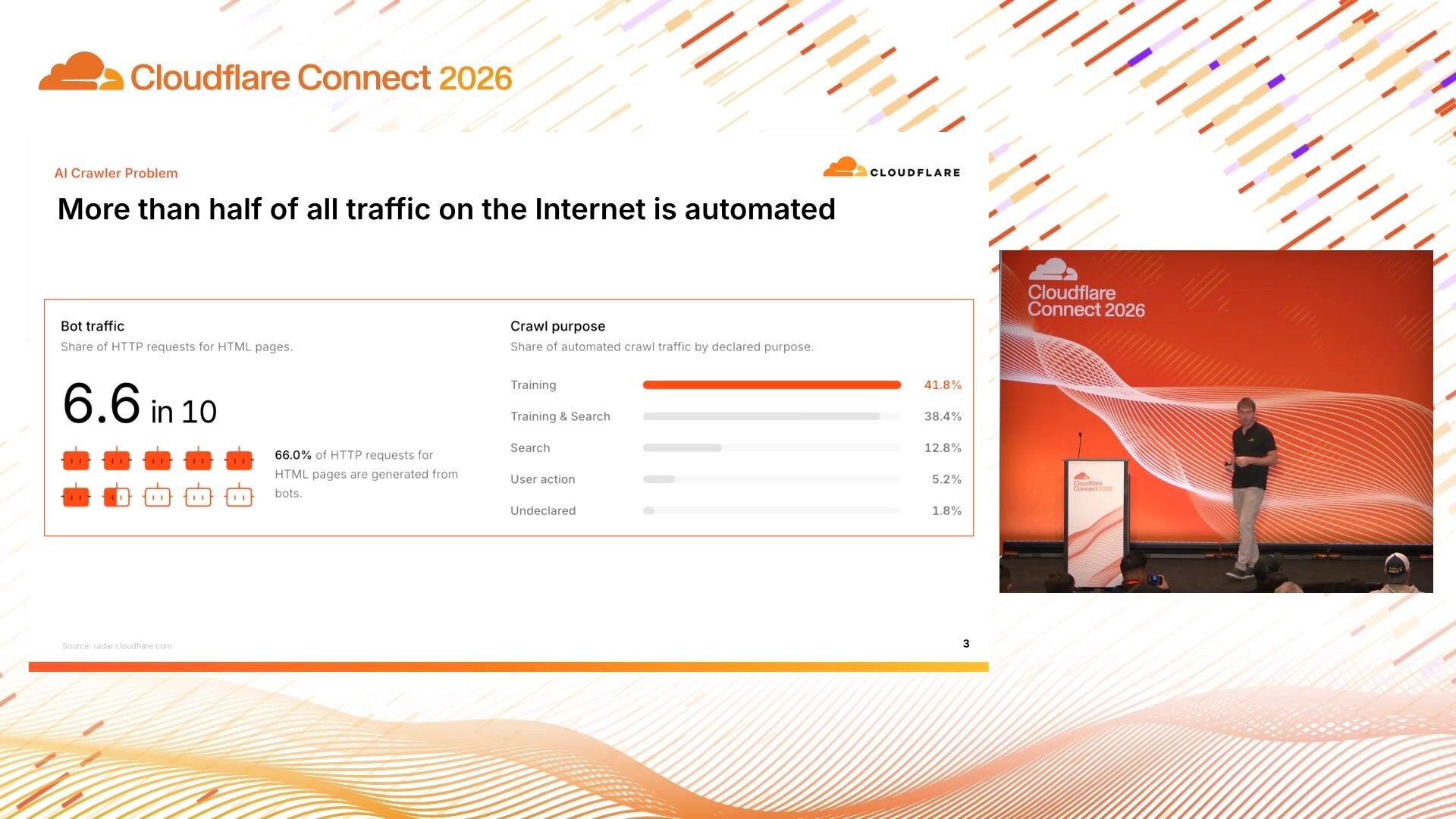
Michael Tremante
Cloudflare
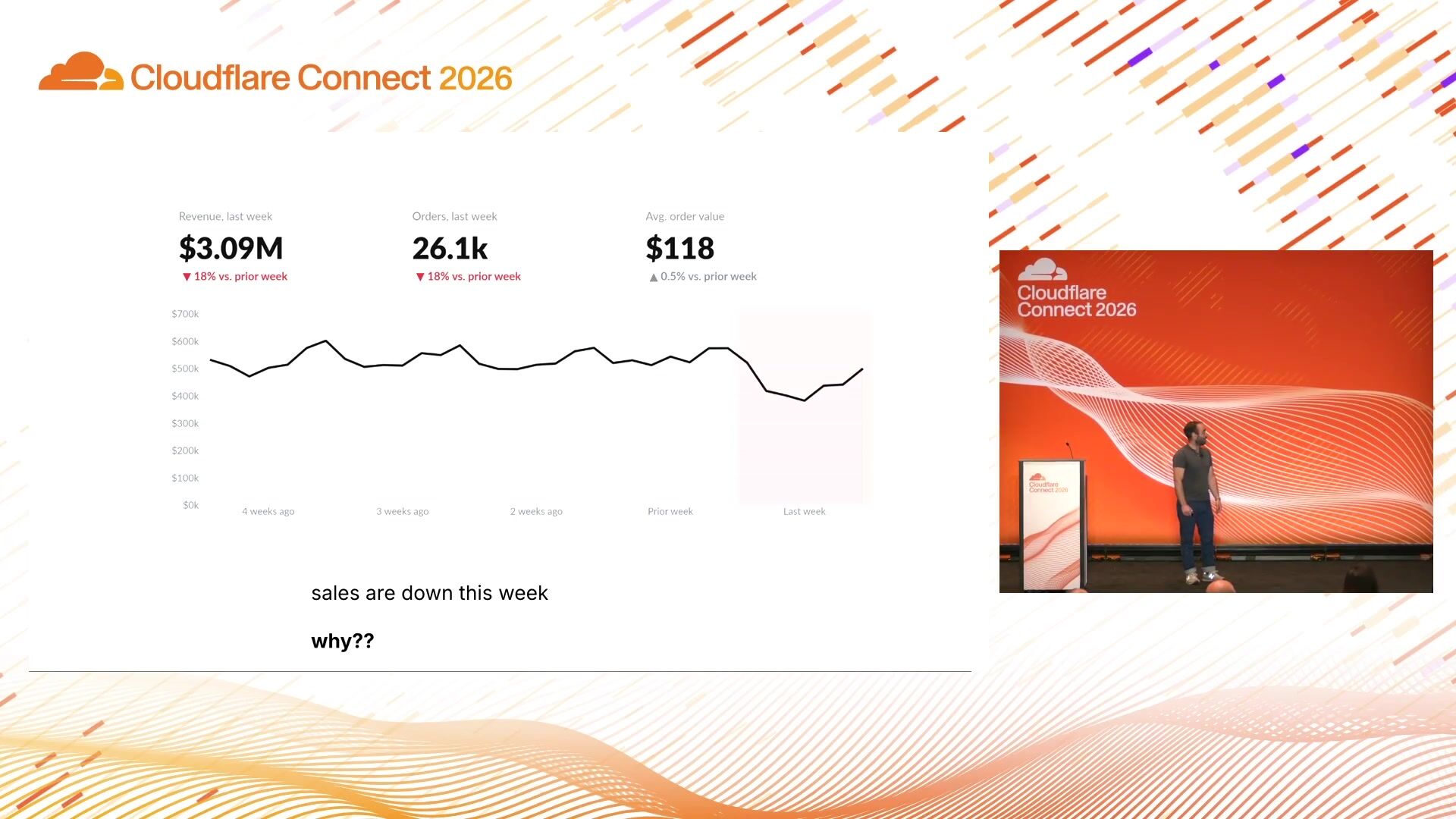
Micah Wylde
Cloudflare
Be the first to know when registration opens and the agenda goes live.
            ---
title: "The Agentic Internet: Building and securing what comes next"
url: "https://www.cloudflare.com/connect/2026/session/the-agentic-internet-building-and-securing-what-comes-next"
year: 2026
---

# The Agentic Internet: Building and securing what comes next

[Watch session](https://www.cloudflare.com/connect/2026/session/the-agentic-internet-building-and-securing-what-comes-next?play=1)

Player: https://iframe.cloudflarestream.com/e33ed6e8f89dfc78d6f7685ee013a74f

## Session details


## About this session

The Cloudflare Connect 2026 opening session introduces Cloudflare’s vision for the agentic Internet, guiding businesses through the shift from AI adoption to secure, large-scale transformation. Join CEO Matthew Prince along with Chief Strategy Officer Stephanie Cohen, Chief Information Security Officer Grant Bourzikas, product leaders, customers, and partners for major product announcements and a look at how organizations are building and securing AI at the speed of innovation.

Enforce rigorous data sovereignty controls without making compromises on resilience, management efficiency, or threat visibility. Cloudflare's Data Residency Architecture provides a stronger path forward — apply for the private beta here: http://cloudflare.com/resource/dra-beta.

## Speakers

- [Matthew Prince](https://www.cloudflare.com/connect/speakers/2425459) — Co-Founder & CEO, Cloudflare
- [Raj Subramaniyan](https://www.cloudflare.com/connect/speakers/2466243) — Senior Vice President of Networking, Oracle
- [Aparna Subramanian](https://www.cloudflare.com/connect/speakers/2493501) — VP of Engineering, Infrastructure, Shopify
- [Stephanie Cohen](https://www.cloudflare.com/connect/speakers/2425456) — Chief Strategy Officer, Cloudflare
- [Jorn Lambert](https://www.cloudflare.com/connect/speakers/2460272) — Chief Product Officer, Mastercard
- [Grant Bourzikas](https://www.cloudflare.com/connect/speakers/2465227) — Chief Security Officer, Cloudflare
- [Kevin Harwood](https://www.cloudflare.com/connect/speakers/2483244) — Chief Technology Officer, Tecovas
- [Dr. Alexandra Heidel](https://www.cloudflare.com/connect/speakers/2465061) — VP, Internet & Content, Telekom Deutschland GmbH
- [Fabian Hedin](https://www.cloudflare.com/connect/speakers/2442768) — Co-Founder & CTO, Lovable
- [Evan You](https://www.cloudflare.com/connect/speakers/2447012) — Creator of Vue.js and Vite, Cloudflare
- [Sam Rhea](https://www.cloudflare.com/connect/speakers/2457284) — Chief Information Officer, Cloudflare
- [Steve Tannock](https://www.cloudflare.com/connect/speakers/2487626) — VP of Platform Engineering Excellence, TELUS
- [Rita Kozlov](https://www.cloudflare.com/connect/speakers/2494861) — VP, Developer, Cloudflare
- [Matthew Conroy](https://www.cloudflare.com/connect/speakers/2421412) — Senior Director, Product Management, Cloudflare
- [Wesley Evans](https://www.cloudflare.com/connect/speakers/2421419) — Senior Product Manager, Cloudflare

## Transcript

[0:00] I want to start out, though, with a rumor, which I heard was going around yesterday here at Connect, which was, how did I break my arm? And I am here to clear up, once and for all, that it was not in a fight with Andy and Matt at AWS. I am, much like Cloudflare, I am significantly younger. I'm more nimble, I'm more agile, I'm friendlier and I think I could take both of them with one arm, no problem. So that wasn't the cause. Instead it was something much more plebeian. I was in a bike accident in Corsica about two weeks ago, I had surgery about a week I now have two plates, 17 screws in my arm so you know it's a little painful but there was nothing that was going to keep me from being here with you.

[0:56] being here at Cloudflare Connect thank you so much it's amazing to do this I also get to try out my sort of David Byrne look so you know if I break into song halfway through you're all too young to get the reference Andy and Matt would have gotten it but um anyway what I was thinking though as I was getting ready for surgery uh was wow what an incredible time we all are living in and what an amazing future we all get to build together and it's actually kind of contrast for quite some time if you actually look at what the web has looked like over the last period of time from 2012 to 2025 it was pretty flat in fact for 13 years we really didn't see much growth across the web and by some measures the web was actually shrinking and from our perspective at cloudflare that was kind of terrifying because we thought web is one of the most things that humanity has ever created.

[1:52] It's brought so much value, so much incredible things to so many people around the world and if it's shrinking at some level it felt like maybe we were failing and we were failing it and we were failing society. And then something changed. In mid 2025 a revolution happened and what we see right now is growth across the web that rivals what we saw in the early 2000s. The web is expanding at an astronomical rate and more and more of it is sitting behind Cloudflare and we're helping power it and I know that some of you out there are thinking oh it's just AI slop and it's a bunch of garbage and and you know there's not anything good and yeah there's some of that but it's not most of it in fact what we see more than anything else this is what's really driving the growth of the web is new creators that for the first time are actually building things without having to have coding skills with how to know all of those things that you used to have to be an expert in, you can get up and tell your stories.

[2:54] You can get up and create your businesses. You can get up and actually bring things to the world in a way that was never possible before. And I think that's amazing. With no coding skills today, you can create incredible things. You can build things in record time with some of the Vibe coding platforms. And what I'm incredibly proud of is that as you use any of these tools from, you know, Lovable to Base44 to, you know, some of the things that they're doing at OpenAI or Anthropic, the number one place, the destination for that code to live is on Cloudflare. And it's incredible to see that growth. And so today, I'm excited that we have crossed a milestone. Last quarter, we announced that we had 7 million developers using Cloudflare. And that was incredible because that was up from just 5 million before.

[3:44] And today, today we've crossed to hitting over 10 million developers on the Cloudflare developer platform.

[3:57] And it's amazing the diversity of that. There are the experienced coders who are saying, I can build faster and better than I've ever done it before. But there are also people who have never touched coding who are saying, I'm able to deploy something and know that it's gonna be fast, reliable, know that it's going to be secure because it is built behind Cloudflare. And I'm so proud of the fact that we are bringing that to more people. Technology, when it's at its best, brings creativity to a larger group. And I think that's what we have the opportunity with the agentic web of delivering. And so most AI builders that are out there deploy directly to Cloudflare and we make it as powerful as we can. And again, technology is at its best when it allows people to express their creativity and do that in a way that they could do without that.

[4:49] What's amazing also is that who is using the web or what is using the web has changed pretty dramatically. When I was here last year, I was asked, when do I think that automated traffic would pass human traffic online? And I forecast it was going to be in the second half of 2027. And that was based on really good data. We looked at everything. that was there fast forward a few months later I was at South by Southwest in March of this year we looked at the same data again and we thought actually it moved up we thought it was gonna be in the first half of 2027 and so I was blown away when in May our team came my team came to me and they said you won't believe this but automated traffic has passed human traffic online agents are more and more what is consuming whatever it is that you put online and i don't think most of us have appreciated how much that's going to change if we extrapolate going forward and and and this is with the caveat that i've been wrong with every prediction way too conservatively so far but if we extrapolate it in five years we think that agentic traffic will be a thousand times what human traffic looks like online to see that visually this is what the agents will look like that's the blue line the orange line is the human line in other words humans are going to be a rounding error online not because people are going to stop using the web we think it's going to hold pretty flat but because more and more it's going to be consumed by your agents they're going to do incredible things I mean we're already see this how

[6:20] can you find me a flight how can you find me a contractor how can you find me a cheaper phone plan I mean it's incredible some of the things that folks like Meadow are doing with Muse and we've partnered with them in order to lot of what they have done we are making this more powerful and it's giving us all superpowers so that you can do more we can take an afternoon's reading and summarize it in a minute and that's incredible and I think most of us here are experiencing exactly what you can do with these new tools and I'm proud that the primitives that Cloudflare has built are enabling more of these tools to run incredibly successfully it does the legwork for you so you don't have to but and again the cloudflare like we're excited for this but it's not free that legwork has real cost and the question is like who should pay for it like let me give you an example if you typed into your chat agent right now where should I go for lunch right you know what what's what's the possible answer it's gonna go out and scour thousands of different menus from thousands of different restaurants that are out there and one of those restaurants gets your business right and that's amazing except the other 99 are carrying the load of delivering that content for that and so if you're one of those 999 that isn't getting

[7:53] people coming to you but you're still having the agents crawl your site, consume your resources, use your bandwidth, consume the servers that you have, then the problem is that we face this massive tragedy of the commons problem where over time it's going to be in the interest of agents to check as many things as possible, but the number of people who are actually going to benefit from that is going to be smaller and smaller. And so last year, when I was up here, I talked to you a lot about publishers, how we were seeing that the traffic to publisher sites was... dropping off of a cliff, and we've worked tirelessly to actually fix that problem and make sure that publishers who are doing incredible work, reporters aren't going anywhere anytime soon, they're really important for our society to exist. We need to make sure that they're compensated, and I'm proud of the fact that at Cloudflutter, we've partnered with the largest publishers in the world in order to get them better deals from the AI companies to compensate them for the hard work they're doing.

[8:47] We need a sustainable ecosystem that supports any- who is a creator that is out there and again we think our role is helping figure out what that sustainable ecosystem looks like what I'm worried about this year though is the restaurant in the deli because I don't quite know what to do about that AI has made it easier than ever to build something and AI has made it easier than ever to build something that is is amazing but agents might make it harder for anyone to find that new thing, right? Think about you today, why you patronize the small businesses that are in your life. Like you might go to the deli because the guy behind the counter remembers your name, right?

[9:34] That's an emotional connection that you have to that. Or you might stop by the dry cleaner because it's on the path for your drive home. It's convenient for you. Humans care about emotions. Humans care about convenience because we only have a limited amount of time. The problem is your agent doesn't care about any of those things. Your agent has almost infinite time. It's not swayed by emotion. It's doing what is best for you, but the problem is how is that going to drive business to small businesses that are out there? The agent isn't driving past the local store. It can get delivery from anywhere in the world. It picks what it knows the most about. means that it's going to pick those things where there is the most information that's out there, which means that the winners, if we don't do something, might only be the largest companies that are out there.

[10:27] In fact, if you don't have a market where new entrants can enter easily, what over time happens is consolidation, where more and more goes behind the big and the powerful, and it's harder and harder for the developers, the startups, the small businesses that are here in the audience. to be able to succeed and I worry about that because I know the story of Cloudflare we not many blocks from here back in 2010 stood on stage and launched this was the entire team at the time in the audience right before we stepped on stage we knew that there were still 27 bugs left to be crushed as Michelle and I started to present we had gotten it down to eight and when we said it was live we thought it was zero and we went live with a new service no one had heard of us before that moment we had a network that was we described as massive it had five data centers across three continents the one in japan only worked about half the day so we had to turn it on and off to not absorb a bunch of traffic from the west coast of the united states and yet like people took a chance on us people bought into it and they bought into it because they wanted to root for us as being successful.

[11:41] The problem is that I worry nobody's agent would have ever recommended us. And if that's the case, how do we make sure that the next Cloudflare is able to be built and launched and succeed over time? People took a chance on us anyway. And what we have to do is make sure that, like the people who presented at Cold Start, I mean, amazing companies that presented showing what they were building, we have to make sure. that they have a chance as well. That's what we're playing for at Cloudflare. We're playing for a world where we can make sure that there aren't five AI companies that are dominating everything. There are 500,000. How do we make it as easy as possible for anyone to build a unique model that's there?

[12:29] We're trying to play for a world where artists and creators, folks like Rashid, Common, are able to not wither away because... AI is just stealing their information, but actually get compensated and paid for their work. We're playing for a world where the biggest don't win by default, but where whoever has the best product, even if it's new, can get discovered. And I think that the thing that I'm spending the time thinking about is what replaces the Internet's old business model, which has done miracles, but also had real challenges, with a new business model that can play for that world where there are many AI companies many media and creators companies many businesses large and small all competing in a way that there is fair and I think that's the most interesting question of the next five years and so again we get another swing at this we get another swing at figuring out and reinventing what the internet has done and we need to think about how we can do things better.

[13:34] So Google, who pioneered scraping and searching, basically just scrapes and search and crawls no matter what. And what you'll see is that when they go to a page, most of the pages that they look at haven't changed. And so as the AI companies built this, they were like, well, that's how Google does it. Let's do it the same way. But that's incredibly inefficient. And so what we said is, how can we actually make this better? How can we partner with great companies like OpenAI to say, let's tell you. when the page has changed so you can get the freshest data without consuming more resources. Because if we can decrease the resources on everyone, maybe the tragedy of common problem isn't as bad. So fetch only what's new, and then get paid when agents use what you've built. And what's incredible is that we've delivered this, and we've got even Google to buy in to thinking that this has to be the future of what is going to have a sustainable internet.

[14:28] And I'm proud of the fact. that the Cloudflare team is leading the charge in making sure that we can build that business model of the future for the Internet. We cut the load and price what's left, and we are very much in the mission of helping build a better Internet. And help is a really important word there. I don't think Cloudflare can do it alone. We need all of you. We need great companies. We need partners that are crazy. And so we have partnered with some of the best companies in the world in order to say, let's build something. it is sustainable. This is too important to just leave up to chance. Let's articulate what that future should look like. A future where we're not, again, going to have just five AI companies, we're going to have 500,000. Where we're not going to have a tight, small number of creators, but all of you can be creators. And when we're not just going to have a consolidated few number of large businesses, but where anyone can start a business and thrive.

[15:17] That's what I'm spending my time on. That's what a huge amount of the Cloudflare. is spending our time on and i can't imagine any work which is more important right now whoever is building what's next they're building it on cloudflare and i'm incredibly proud of that the agentic internet is here uh it's amazing for what it is going to be it also has some challenges that we need to think about and get ahead of and work on i'm proud of all of the work uh that we're doing and so with that i'm going to hand it off to our chief

[15:56] who is going to talk to you about everything that we're doing in this space. Thank you so much. Thank you for being in Connect. Stephanie, break it.

[16:10] Thank you, Matthew. Rashid said it quite beautifully. And Matthew showed you the numbers. The agentic Internet really is here. Models may have been the foundation of AI, but today's world, it is dominated by agents, and agents are different. A model decides, while an agent acts. Deciding is uniquely a GPU problem. Acting is a CPU and a network problem. In some ways, agent behavior mirrors human. behavior, they get things done, and they make mistakes, or at least this human does.

[16:58] But an agent uses the network differently from a person. Matthew told you that an agent reads more pages in a minute than you could in an afternoon. A person will pass out eventually, an agent doesn't. People will trickle in, but a million agents are going to go after the six. same thing in exactly the same second, a person will log in as themselves but an agent arrives on someone else's behalf. Humans have always demanded a lot from the internet, but those agents, they need even more. They need a network. It's fast on every call, has room when demand spikes.

[17:46] keeps working when something breaks and is protected from attack. GPU clouds were built for deciding, but acting happens on a network. Matthew told you that in 2010, we launched our network with those just five data centers on, I guess, three continents, but we've been building on it ever since. I'm going to start with how close we are to every single thing on the network. internet but why does that matter when an agent acts it's acting on the internet on a website an API a store a database more than one in five websites on the internet uses Cloudflare as you move through the internet every day hopefully not during this presentation you touch Cloudflare continuously agents they're doing exactly the same thing They're just doing it a lot more often.

[18:45] So for a large share of what agents do, the thing they're interacting with is already on our network. It's often on exactly the same machines. Our network today spans more than 340 cities across more than 130 countries. But those dots on a map tell you where a company has equipment. They don't tell you whether the same services run everywhere. In a traditional cloud, different regions offer different products and traffic travels back to a regional hub for security or for compute or for data. At Cloudflare, we took a different approach. Every single service runs on every machine across our network.

[19:30] So an agent acting for someone in Tokyo actually runs near Tokyo. It doesn't make a round trip to Virginia for a security check halfway through its task. and nobody building the agent had to assemble a global footprint to make that true. They inherit it directly from our platform. Cloudflare connects directly with 14,000 networks, and direct connections make things fast and make them reliable. Our global, highly interconnected network means that Cloudflare is within 50 milliseconds of 95 % of the world's population. So how fast is that? A blink of an eye takes approximately 400 milliseconds. We're eight times faster. For a person, that's going to make a website or application feel immediate.

[20:20] For an agent, it compounds. At 50 milliseconds a call, an agent makes 30 calls in a second and a half. That's the time it takes another agent, a region away, at 300 milliseconds. to make only five. Speed isn't a region our customers have to choose. It's a consequence of our platform being everywhere.

[20:47] That's fast by default. Our network has nearly 600 terabits per second of capacity. That number is almost impossible to fathom. So I'm going to try to put in a little bit of perspective. When Cloudflare... at TechCrunch in 2010, we had less than one terabit per second of capacity. But just two years ago, we were only at 250 terabits per second of capacity. So in two years, we've more than doubled to a level of network capacity that is greater than most countries. But why does that matter? When millions or even billions of agents go after the same thing, it could be a product launch, a ticket drop, a break. the demand will land in exactly the same second.

[21:36] So does an attack. Nobody building an agent or interacting with one should have to predict that spike and provision for it. Our network just absorbs it.

[21:49] That's scalable by default. The Internet, it feels virtual, but it's actually physical.

[22:01] Cables get cut, routers will fail, data centers are going to lose power, weather, construction software and simple human failure all can disrupt a connection. The question isn't whether something will fail, it will. The question is, who notices? A person notices, they'll hit refresh, they might come back tomorrow. An agent acting for someone who isn't watching, maybe your agent. agents, they don't have anyone to hit refresh. The failure gets routed around or that task just fails. When part of our network becomes unavailable, traffic can take another path. The application will stay online and the agent will just keep on working. Go agent. That's resilient by default.

[22:47] Security is built into our network. It isn't a separate stop traffic makes on the way. to an application. As I said before, it runs on the same machines. And our scale makes our network smarter. The more it sees, the faster it recognizes what's dangerous. When we spot a new attack on one customer, what we learn protects every other customer on our network. That's secure, by default. For the last 20 years, building globally meant making choices. I'm going to show you what that can feel like. We're going to imagine for a minute that this room is the world and each area is a different region.

[23:35] A traditional cloud would ask me to choose where I should run this presentation. I'm going to choose over here.

[23:48] You can hear me. For you, the experience is... But most of this room, they're having a really bad experience.

[24:06] Welcome back. So for part of this room, nothing went wrong. The presentation was just working. But it was simply working in the region I selected. No hard feelings, sorry about that. But this is the trade-off. we've been asking our customers to manage. They choose where an application runs, who gets the fastest experience, and what happens when a region fails. At Cloudflare, we start with an entirely different assumption. You get to deploy once. Your application and your agent working with it runs across our entire global network, close to whoever is serving. Compute and storage and inference, networking and security all run. on exactly that same network. Routing and scaling are handled by our platform.

[24:53] And global, though, doesn't mean giving up control. You get to decide where your data is processed, where your encryption keys are stored, and where your logs are kept. Global availability with local control. Other clouds ask you to choose a region. At Cloudflare, we give you region Earth. The Internet was built for humans. Cloudflare was built to make the Internet faster, safer, and more reliable for everyone. It turns out that same architecture is uniquely suited for agents. Agents are more numerous, they act continuously, and they can create enormous demand at machine speed. They need infrastructure that is close, elastic, resilient, and secure, all by default.

[25:44] Cloud Flare's network was built before the agentic era, but it was built for this moment. One network, one platform, available everywhere. Built for humans, ready for agents. This is where the agentic internet gets built.

[26:15] so many of you know us as that company that acts as a filter that sits in front of your website it makes it fast and it keeps it safe that's still true but our same network we now run code store data run inference and host agents we're a platform and the rest of this morning it's about what you can do with it today we'll show you how you can build, secure, and scale with Cloudflare. I just talked about scale. We'll take the rest in just two parts.

[26:51] First, we'll cover build.

[26:56] Rita is going to show you how to build and run agents on Cloudflare. Evan will show you how to make what you build fast for everyone. and for everything that uses it. And Matt Conroy will show you how you can stay in control and get paid on an internet where more and more of your visitors are agents. We're then going to move on to secure. Wesley and Grant will show you how to keep your data, your network, and your people safe. Then Sam will come out and show you how we put it all together inside of Cloudflare. Along the way, you'll get to hear from our customers. partners who are already building on us. Rita?

[27:51] Thank you, Stephanie. All right, let's do a quick show of hands. Who here has used workers before?

[28:04] of hands up. It actually makes me emotional to see it grow every year. And it's, believe it or not, been 10 years since we originally announced Workerz, which marked the beginning of our developer platform. Now, there's no way we could have known it at the time, but Workerz has turned out to be the perfect foundation to build on, especially in the agent era. Let me explain to you why. Workers wasn't the first ever functions as a service service, but it was the first ever cloud primitive that was built not on VMs, not on containers, but on isolates.

[28:50] The reason that distinction is very important is because isolates can uniquely, unlike VMs or containers, only bring in the application. code without having to spin up the entire process overhead every single time. This results in orders of magnitude added efficiency, a hundred times more efficiency, in fact, which in a time of abundance of code, like we're living through with agents right now, becomes really important. But of course, workers was just the beginning. Today, our developer platform spans many products and services that enable you, developers, to truly bring your ideas to life.

[29:35] Anything that you need, storage, compute, databases, if you need email for your application, agents, images, videos, you can find it all in one place on Cloudflare. And what's truly remarkable is that today, as Matthew said, there are over 10 million developers that are building. Cloudflare, and that doesn't even include the agents. For the first time ever in history, the way that we're building software, though, is changing. It used to be pretty simple. As a developer, what, you write some code, you ship it, then a user logs on and uses it. That's it, right? Okay, maybe it was never quite that simple. I don't know if you guys remember three years ago, but we used to write all of that code by hand, every last semicolon, and then you would have to go in and test it locally to make sure that it worked.

[30:33] You would then push it up. A coworker of yours would review it. Eventually, it would make it to production. And then a customer would log on, start their day, and they would start clicking on buttons, right, and looking at dashboards and buying. things and filling out forms, and eventually they would run into a bug in that code that you wrote, or they would find a feature that didn't exist quite yet and ask you for it, and you as the developer would go back to the drawing board, and the cycle would start all over again. But this is now all changing, because it's no longer just a developer or a team of developers. It's a team of developers and a whole army of agents.

[31:19] And on the other side of it, it's no longer just the customer, but it's a customer and all of the agents that represent them. And as Matthew and Stephanie already talked about, agents and humans are fundamentally different. But the problem with that is that the cloud as we know it, both on the software development lifecycle side and the web itself, have only taken humans into consideration. So, it's time for a different cloud. Let's talk about what that means, and we'll start with the software development lifecycle. The SDLC was built for humans, but the thing about agents is they are incredibly efficient at things that we can be quite slow at.

[32:08] In fact, the part of the process that used to take the longest, writing out all of that code, that's actually now the shortest part of the journey. And agents are much faster at other things, too, reviewing code, deploying it. But there's one thing that's getting in the way of you being able to take full advantage of that. And it's that it's kind of scary to give your agents access to your production environment. Now, we're in San Francisco, the city of self-driving cars. But for us to get in that car for the very first time, we had to be really... confident that that car was going to be a better driver than we were, because inherently we trust other humans more than we trust machines, right? And now for you to be able to take advantage of all of the gains that are to be had from letting agents run loose in your code base, you need to be able to build up that same trust.

[33:03] And the tools to allow you to do so, that's exactly what we're building at Cloudflare along every single step of the way. We're reimagining the SDLC or the agent development life cycle. Let's walk through a few examples. With agents writing code in a brand new level of velocity, the tools that were built that assumed that humans were going to be writing all of that code, they can't keep up. They're not scaling, right? We're building more websites, more applications. There are more PRs being created. And, well, the source control that we've had so far, it just doesn't scale. So that's why earlier this year we announced Artifacts.

[33:51] Artifacts is version storage that speaks Git that was built from the beginning for agent -level velocity, and it just went into open beta two weeks ago. But uploading the code is just the first part of deploying it, right? Next, you need CICD. And that's... where, again, we're reimagining CICD for the era of agents because agents don't actually have to go through statically defined steps every single time. Agents can dynamically think about what's going to happen next, what features your customers are going to click on, and go and test those out, find bugs and fix them before they even make it into production. Lastly, for you to be able to have that trust, the thing you need most is visibility.

[34:39] And that's what we're providing you with Cloudflare traces. We want to give you the observability that you need along every step of the way into what your agent and what your code is doing in production, such that even when your humans are asleep, your agents can go in, find something that's going wrong like an exception, fix it, and roll it out before the humans even notice.

[35:05] So that's the SDLC part of it. Now let's talk about the web, or the applications, because the requirements are changing there rapidly, too. As Stephanie was saying, agents are capable of generating much, much more traffic than humans. So what was considered to be scale yesterday is going to be nothing tomorrow. And if you remember the bet that we took with isolates, well, this is the moment that they were built for. This is exactly what workers do. is really, really great at. It's being able to scale from zero to 100 instantaneously without you having to do any pre-provisioning and without you having to intervene in any way. Anything that you build on Cloudflare will just scale. And it's not about just executing the same code over and over again.

[35:53] The thing that's unique about agents is they require their own execution paths. And for them to be able to have that, what you need... is hundreds, thousands, millions, or even billions of little environments, little sandboxes. And again, that's exactly what we provide you with with dynamic workers, is that ability to spin up a sandbox, just run that code, and move on.

[36:21] But if we're talking about applications changing, well, agents are just another type of application. The thing that makes... it unique though is the thing that sits at the heart or I should say the brain of every single agent and that's the model which is why with workers AI and AI gateway we're committed to always providing you and your agents with the latest and best available models on the market but that's not it just yesterday we announced a brand new model called cleric it's not just a new model, it's a new type of model, an extraction model. It can take unstructured data, imagine something like a receipt, you don't know how many items it's going to have, you don't know what all it will contain, but it can take that data, extract it, and give it to the agent.

[37:13] We think this is very complementary to something like decision models, like Clef, which we announced two weeks ago, which was Cloudflare's first ever owned model. It's performing at the top of the benchmarks today. It's incredible. incredibly fast, and available for anyone here to use.

[37:37] All right, I'll be honest. I could stand up here and talk about all of our products and features and ways to build agents for hours. It's a good thing that they didn't let me do that, but instead we have a whole two-day track that's dedicated to agents that has really incredible speakers. I encourage... every single one of you to check it out. And on that note of hearing less from me, I'm excited to welcome on stage Fabian Hadeen, the co-founder of Lovable, to talk about how and why an agent-native company is building on Cloudflare. Fabian, coming up.

[38:26] So good to have you here. Thank you for joining us. Thanks for having me. Very exciting to be here. Flew over from Stockholm, Sweden, where we're headquartered here just yesterday. I want to talk to you all about what we're doing. And I think Matthew did a great job kind of laying out the lay of the land of this authentic era and how creators are being empowered to create. more than ever. And that is what we're all about at Lovable as well, helping people go from their idea to actually making it real out in the world. I'll skip the slides and I'll just talk about Lovable. I heard you like to show rather than tell. Exactly, exactly.

[39:12] We're going to do a demo here as well. But I just want to talk a bit about the scale of what has happened here. So you've talked about how your platform has grown so fast because of all of these new people being able to come and create. And we started in 2023 exploring this, and we set out on this mission to create something that anyone could use. And so we've really focused on simplicity. And so what is lovable then, actually? So on screen here, we have a prompt box. And you can ask Lovable to create things for you. And so I have a quick demo I thought I would do where I'm doing a session later today around some of more the technical deep dive around our partnership and how we're using Cloudflare to host all of these 70 million websites that we've created on our platform.

[40:09] And so I thought I would create a landing page for my session. So I'll ask Lovable here. Hey, Lovable, can we create a quick landing page for my session I'm doing at Cloudflare Connect? I'll give you some quick context. And then I'll just paste in some info around my session. And so it's always fun doing these demos with AI, because as we know, it's non-deterministic. So we see what it actually puts out. No one knows. But. I'm hopeful, I'm confident, and so right now, yes, great, and so currently now, I sent this prompt away, and so Lavable is beginning to understand my prompt, it's looking through some of this information I pasted from your website, and it's starting to write the actual code to build a landing page for us, and this would take me as a developer, maybe not this quick, right?

[41:15] So this took around 40 seconds or so for me, an hour maybe. But here we got some initial version of our site. And so I'll be talking about and workers and all of this stuff. And if you're interested around this, come to my talk later today. I got a preview. But I'll paste another prompt here as well. And so we've seen that writing software has gotten really easy. And so we're all about removing the bottlenecks to creation. And so what we've started focusing a lot on is, okay, what happens actually after you create a software, after you write this code? And so the first thing, of course, here is that you want to host this.

[42:01] And so we use Cloudflare workers, dynamic workers. We use KV, R2 to... of this, and then you also need a database. We help you set that up if you need payments, emails, and 200-plus connectors. We have the Cloudflare API as a connector, as an example. But basically, just helping you focus on the idea itself and not have to care about anything around really the execution about implementing this. And so you can just work on this high level of abstraction. And so I asked it to add a QA form here. the bottom, and we see, oh, there it appears. And so now if you want to ask some questions for my session, you can do that here. And I'm quite happy with my site here, spending a few minutes on it.

[42:48] So I'll go here and I click publish, and Lovable generates a subdomain for us. I could add a real domain if I want. I'm happy with this. So I'll press publish, and hopefully we'll have. site live in a second or two. And so this is all hosted on Cloudflare with the workers, and it's something where it's become so easy to do this, right? And now I showed you a very simple kind of example of creating this landing page. It's been up a database for us and other things in the background, but we didn't really have to care about it. And so we see people... everywhere from solo builders to two-thirds of the Fortune 500 use this platform to do everything from simple landing pages like this up to actually very complex applications such as SaaS platforms.

[43:42] And so this is what we're all about, empowering the 99 % people closest to the problem and enable them to take their ideas to reality. Thank you so much. Thank you for joining us. It really is the best time to be a builder. Thank you. Thank you, guys.

[44:03] I don't know if you guys noticed how quickly the application itself was updating after there were code changes being made. And actually, you have our next speaker to thank for that. He and his team are building the tools that enable applications to be built fast and be fast. So please help me welcome on stage Evan Yu.

[44:34] I've spent more than a decade building open source tools for the web, and for most of that time, the web stack was much harder than it needed to be. There were way too many moving pieces. It took too much effort to put together, and it was very easy to end up with slow feedback loops if you're not an expert. That was the problem I wanted to fix. I started at the framework layer with Vue and went deeper into the toolchain with Veet. Veet gives you instant feedback when you change your code, so you can stay in the flow. Today, Veet is downloaded more than 200 million times every week. It powers applications built with mainstream frameworks like React, Vue, Astro.

[45:19] It also powers applications built by AI coding agents. That last part matters. AI can generate code very quickly, but if every build, test, and preview is slow, the agent is still slow. Faster creation requires a faster loop, particularly so for agents. At void zero, we set out to build a fast, unified toolchain for JavaScript and TypeScript. We shipped V plus as a result. Then, we started building Void, the native deployment platform on top of Cloudflare. That made something obvious to me. We didn't need to recreate a cloud. We needed to connect the tools we knew how to build with a platform that was already

[46:10] That's why joining Cloudflare made sense. My team can stay focused on compilers, bundlers, linters, test runners, and caching. We can keep that work open source and keep building with the community. And together with Cloudflare, we can carry the same fast experience all the way into production. The goal is one development model from the first file all the way to production. You should be able to use Cloudflare services locally, iterate quickly, and trust that what worked on your machine will work when you deploy. Less translation, less configuration, fewer surprises. Because speed isn't one fast build. Speed is preserving momentum across the entire process.

[46:59] But getting to production quickly is half the story. Once the application is in the world, your users need it to be fast, too. That includes people, and increasingly so, agents. A person might wait on one page, an agent may make 20 calls in sequence. Stephanie showed you what distance does to an agent's calls. Every round trip compounds, latency becomes part of whether the task finishes at all. This is why we automate optimizations in the tool chain and why the Cloudflare network matters after deployment. The application is built efficiently, delivered close to the user, and fast by default. product. Deploying globally is important, but global doesn't automatically mean fast.

[47:51] Over the past year, the number of requests handled by Cloudflare's proxy doubled. Normally, you'd expect that additional load to make the system slower. We saw the opposite. While serving twice as many requests, we cut processing time roughly in half. Both average performance and P90 performance improved substantially. More traffic entered the network, but each request spent less time inside it. That result didn't come from one feature. It came from improvements across the platform working together. A more efficient proxy, faster and more stable connections, and optimizations across routing, caching, and application performance. This is the other half of creating best-in-class experiences.

[48:36] We help you build and ship faster, then the network... keeps your app fast as demand grows. If you want to go deeper on the network, performance, and framework behind all of this, we have two full tracks over the next few days, network and infrastructure and web performance and frameworks. I'll be there, too, talking about developer tooling in the agentic era. I encourage you to join me. Now we're going to show you what network performance means for a business. Without a CDN. Every page has to come from one server far away with cloudflare. It comes from a city near the user less distance less waiting The page is just there So rather than have me describe that from the outside I'd like you to hear from the people who work on it every day Please welcome Stephanie back to the stage joined by our customers from Shopify and Tekovas

[49:32] Let's do it

[50:00] Well, I'm super excited for this session. I even... And dress for it. Check out the boots. Kevin's team sold them to me, but Shopify, Tecovas, and Cloudflare all had a hand in how. So, Aparna, though, I'm going to start with you. When a shopper taps on a product, every second counts. Shopify storefronts are run on Oxygen, which is the world's best product name, but that runs on Cloudflare. So, I want to talk about how you're making your sites faster for your merchants. Yeah, absolutely. So at Shopify, we are obsessed about performance and minimizing our latency. And like Stephanie mentioned, TechOvers runs on custom storefronts, which is our Oxygen's platform.

[50:46] And Oxygen runs on Cloudflare workers. So the first thing is the storefront is rendered in a location that's as close to the buyer as possible. So that's one. And then we cache as much as possible, like all the images. the scripts, the CSS, so it's all cached in the CDN layer, so it's also running as close to the buyer as possible. And then the third thing is we really, for the requests that have to go back to the origin, it uses Argo smart routing, which is the most optimized, fastest path to go back to the origin as possible. So those are the three things that we do, and at Shopify, we are also, like, paying a lot of attention to tail latencies because at Shopify scale, P99, when you're serving half a billion requests per minute, is millions of buyers.

[51:39] So we are continuously profiling the request paths and making sure that the request is served in the fastest possible manner. Okay, so, Kevin, I want to talk to you. Your boots are nice. I think you have 40 pairs. Those are bigger than mine. Close, yeah. Those are much bigger than mine. So you're online, and you started there, but you actually have stores across the country, and you decided to go all in on Shopify four years ago, and you run on Oxygen, which runs on Cloudflare. But I want to talk about what you've built on top of that foundation and how it goes all the way into the stores. Yeah, speed is important to us. It keeps customers moving and browsing through the entire Tecovis .com journey all the way through checkout, and it matters especially during our... and Q4 in the holidays, which is just a couple of weeks away.

[52:29] Shopify and Cloudflare take care of all of that infrastructure for us, and that enables my team to be able to focus on creating incredible experiences for our customers. And on top of that foundation and in this world of agentic development, we've been able to do even more on the site. We've built our own custom product recommendations engine. We've built an A-B testing platform system, and we've even deployed our own techovus .com chat bot all built internally and hosted on Cloudflare. And at Techovus, we strive to serve our customers with radical hospitality. In stores, when someone comes in to try on boots, we want our associates focused on them. We don't want them disappearing into the stockroom or trying to coordinate something over a radio. And that's why we built Bootrunner to help deliver on this hospitality.

[53:17] Here's how it works. the associate can request a size directly from Shopify point of sale there's a runner in the stock room who gets an alert immediately on their handheld and we also have a TV dashboard that shows the entire operations of the retail store in real time our HQ team can even check in on the entire fleet and see it from our entire macro perspective it's incredible and runs completely on Cloudflare and delivers real -time updates across all of the services it's built on top of Shopify POS UI extensions, 100% built with AI agents and maintained by AI agents. We aren't building a point-of-sale system. We're trying to build a Tecovus experience on top of it. So, bootrunner's one thing.

[54:02] Super cool, but you've built a lot more on top of Shopify and on top of Cloudflare. Can you talk a little bit more about what you've been building? Yeah, we are truly building on the shoulders of giants. Shopify provides us all of the commerce building blocks. And Cloudflare provides all of us the infrastructure and security. And when you add AI into that, it's incredible what teams can do. We're taking on business problems across the company that were way too big for us just a year ago. And now we're doing things like building our own homegrown BI platform with agents that serve data to all teams across the company. We've also built a supply chain command center that's built by the actual team members of the supply chain team. So they're able to help build the software. they need to get their jobs done. My team's development output has increased over 400% just this year alone.

[54:51] So, Tekoa is an A-plus student, but talk to us, Aparna, about what you're seeing across the entire Shopify merchant base. Yeah, definitely. AI has given all of us superpowers. We are seeing this across the board. And what I'd say is the benefits of AI is threefold. One is, you know, it has accelerated the innovation, you know, for people like Kevin, all of our... merchants. The other thing is it helps buyers find exactly what they're looking for. So if Stephanie goes to her favorite agent and says, like, I want black color boots, you know, no laces for my Cloudflare keynote, she gets taken straight to TechOvers, right? And it helps Kevin find the exact customer who's looking for exactly what he has. So, like, you know, what we call this as, like, merit-based discovery.

[55:38] So helping man. match buyers to merchants, and, you know, we don't want, like, all of the merchants to take on the task of having to integrate with every single agent out there, so that's why Shopify has launched UCP, which is Universal Commerce Protocol. We co -developed it with Google, so what it does is it enables agents to buy directly with the merchants, so it's an open standard that specifies how an agent interacts with the merchant, and using their checkout. using their rules so yeah so like you know the shopping experience starts with the agent but ends with the merchant and every merchant on Shopify has UCP enabled by default so any agent can go shop on their website amazing well thank you Kevin thank you Aparna thank you both for being here thank you for being

[56:37] I strongly recommend the boots. They're awesome. Tecovus is moving so fast, but they're doing it without giving up control of their brand, and they're getting ready for agents without having to rebuild their business. I'm now going to welcome on Matt Conroy. He's going to go through in greater detail how every business, not just Shopify and Tecovus, can retain control and optimize and monetize on the agentic Internet.

[57:15] I'm sad I didn't make the boot cut for the new boots. I must say before I get started, for a day that we're going to spend a lot of time talking about agents, it is so nice to see so many humans in one room.

[57:29] So, indulge me for a second and picture the So, if you're like me, you probably still see people reading, shopping, booking a flight. But as you've heard many times already today, that is just the tip of the iceberg. And at Cloudflare, we see what's underneath it all. And what we see are agents in astounding numbers. Last quarter, AI agents made more than 600 billion records. requests on our network, almost four times as many as at the end of last year. And in the time it takes me to finish this one sentence, we will see one million more.

[58:16] Now you just heard how Tecovus and Shopify think about every millisecond of a shopper's A person like me might check five stores, if you're lucky. But as agents do more. of the shopping on our behalf, this number is set to explode. An agent may check hundreds of stores and ask every one of them for prices, sizes, and what's in stock. Now, every one of those requests costs the store something, and most will never turn into a sale. But it's not that people have stopped coming. Human traffic on our network is up more than half since early 2025. but automated traffic has doubled. And that means for almost every business, traffic is growing faster than revenue.

[59:07] Now, our job is to help you serve the whole Internet, not just the part you can see. In practice, this means giving you tools to control it, to optimize for it, and, of course, to monetize it. Okay. Control starts with knowing... who's there. And with agents, we're really talking about three questions. Who is it? Can we trust them? And on whose behalf are they acting? Now, many AI companies already signed their agents' requests with Web Bot Auth, OpenAI, AWS among them. And we're working with everyone building agents to make sure getting verified is easier than ever. And we're working with the ecosystem at large to help shape the rules as we go.

[59:54] but you might ask what about the ones who choose not to verify who they are well that turns out to be most of them fewer than one in ten automated requests comes from a bot that identifies itself but not to worry our network sees enough to understand what they're up to anyway and we will publish what we find on cloudflare radar of course once you know who's there you get to decide what they get. Soon, agents will be able to vouch for the humans they're assisting with an anonymous ID, the operator's own guarantee, or a verified identity. We'll provide the controls, but you get to make the call. You can let a vouch for shopper check out.

[1:00:40] You can turn away any agent that can't vouch for anyone. And if a single person abuses an agent, you can block that person. without blocking everyone else who's doing it right. Now, that builds on controls that every Cloudflare customer already has, search, training, and agents, set separately and enforced at the network level so your choices hold. And as Stephanie mentioned earlier, underneath it all, adaptive intelligence, which retrains continuously on traffic across our network. So a new fraud technique that shows up today can be recognized tomorrow with nothing new for you to configure. That's control.

[1:01:25] But protecting what you've built is only a piece of this puzzle. You also want to be discovered. Matthew asked an important question this morning. When agents are doing the browsing, who actually gets found? This matters because if you're not discoverable to the agents your customers are using, You're effectively invisible to the humans behind them.

[1:01:50] Our agent engine optimization tool asks leading AI assistants the questions your customers are already asking, revealing how you stack up against competitors, in what context, and which sites shape the answer. And because we also see which AI tools are reading your site and what content they're most interested in, you can stop guessing. what AI says about your brand and start shaping it instead. But visibility is just the start. By early next year, our goal is to help you win more customers with AI and give you a bigger say in how your content shows up in AI Answers.

[1:02:35] Now, earlier this year, for the first time ever, crawlers collected data to train AI models were fetching more from the web than Google's own search crawler. Incredible, right? And for every visitor that some AI platforms send back to a site, they crawl it thousands of times, sometimes tens of thousands of times, often rereading pages that haven't meaningfully changed. But we don't think getting found should cost so much. So we're working directly with the companies that run these crawlers to help them crawl smarter. Sure, less waste, but also better discovery.

[1:03:22] I'm excited to announce that in a recent experiment with OpenAI, leveraging just 1% of our global network, we helped them find and index hundreds of millions of new URLs they had never seen before.

[1:03:46] This should be especially exciting for all the smaller sites, local businesses, and unique stories out there that have always struggled to get noticed.

[1:03:59] All right. That's all well and good, Matt, you might say, but we still need to talk about money. Remember that age. checking hundreds of stores well right now every one of those requests is a cost but each one is also representing an agent that wants something that you have and that means it's not just traffic anymore it's also a customer and where there's a customer there's value to exchange our monetization gateway lets you put a price on anything that passes through Cloudflare a page a data set an API even an MCP tool, an agent asks, we respond with the price, and it pays you directly. That means a sports stat site can charge a fraction of a cent every time an agent asks, who leads the league in assists?

[1:04:52] And when AI uses your work in a summary, that's an exchange too. With pay per use, AI companies can make you an offer. You can count. offer. You can say yes and get paid. And critically, you can also see exactly what was used and what it earned. But it's not just about getting paid for information exchange. Once agents can pay, something bigger opens up as well. Whole new ways to shop. And we want every business out there and in here to be able to build those agents and transact with them too. Imagine a world where you can tell an agent what you want, your goal, your timeline, and your budget, and it does the rest. This is my personal favorite example, taking my toddler skiing for the first time.

[1:05:41] But to do that, for that to work, the agent has to understand and find what you want. The merchant needs protection from fraud. You need to get the right agent in the door. We can help with that, and we've just talked about how. And that agent needs the right permissions. needs to be able to check out with a real payment behind it. And speaking of that payment, the money has to move at the speed of software, which is why we back open standards like X402. So you put all these together and you can control what reaches you, optimize to be found, and monetize what you're worth. Now both sides of this market already run through our network. More than 20% of the web, and nearly 80% of the web, and nearly 80% of the web, and nearly

[1:06:28] We can see the internet changing in real time and that's why we can help provide what it needs. A network that can carry all that traffic, as Stephanie talked about. Payments that keep up with it and open standards that anyone can build on. Since day one, more than 16 years ago as of last month, helping build a better internet meant making it work for the people using it. Now, it also means making it work for the agents acting on our behalf and for all the businesses who intend to serve both. The Internet that you can see isn't going anywhere, but the part underneath is growing faster than ever. Build here, and you can be ready for both.

[1:07:16] Now, I'm incredibly excited to dig into all of these topics and more during our many breakouts. sessions this week, so please come and find us. And with that, I'm going to pass it back to Stephanie and one of our fabulous partners who's working alongside us to make the future of agentic commerce you just saw there a reality, MasterCard.

[1:08:12] Great music. Nothing like a beat to get it going. Jorn, thank you so much for joining. us thanks for being our partner easy question there's so much that's gone on in the last year why don't you tell me what you're most excited about well right now standing in front of an audience here is pretty exciting i think thanks for having me here in san francisco fantastic event and these guys know how to put up a show and but look so much is happening we spoke about this this morning agentic is is exploding both for consumers and maybe more importantly we're seeing or machines interacting with other machines, interacting, collaborating, buying and selling, compute, inference, other types of resources. And to us, we believe that we're at the start of what is a Cambrian explosion of innovation where lots of you here in the room will create services and resources for machines to consume.

[1:09:10] That will open up a whole new economy. But for that to work well, and needs payments. Nadea is launching a new health bar. Its agency handles the campaign. I think they're going to show us how. Its agent makes it happen and pays for it. Look, listen. Meet MasterCard agent pay for machines. One prompt, a few product photos, and the agent gets to work. It finds certified providers on the MasterCard network, scripts, images, voices, video, and comes back with a proposal. It asks for a $400 budget. approves bank account card wallet or line of credit with MasterCard agent pay for machines that approval becomes a verified spending limit recorded in a smart contract up to that limit nothing beyond it contracts the work a script eight cents an image 42 cents a voice sample 55 cents commissioned in real time payments secured by MasterCard later the creative assets are ready to review the agency stays in control its agent runs the production mastercard agent pay for machines runs the payments each provider is paid in the currency chain or rail it prefers and just like that the campaign is ready to go so so that that got a little ahead of our skis here what this video is showing is what i'm actually about to demo in production in live production.

[1:10:39] Now, my mentor used to tell me, very wise man, never bring live animals or live production demos to a big audience. But hey, this is a developer conference. Let's live a little. Let's try this. And so what you will see is us making a payment or a series of payments that are secure, that are permissioned, that are interoperable, and most importantly, that are accessible to everyone. One, as Matthew Prince earlier said today, we need to develop this in a way that is truly open and truly accessible for the largest company and the smallest one. So let's try this. So I'm all here. My friend will drive the demo. As you can see, similar to the video, a real company, Hype, which is a marketing agency, has a task here for creating a marketing campaign for that new Nutella brands.

[1:11:35] When Amol presses the bottom, the agent gets to work. This is an agent on AWS agent core, which starts with three things. They break down the task. They identify the resources that can actually complete the task. In this case, ISA, which is a marketing or a research agency, and Cloudflare AI gateway that can provide the resources. And it proposes a budget. as you can see the budget proposed for those tasks is $3 .50 I have a number of funding sources in this case I choose my digital wallet because I have some stable coin laying around and as I'm all proceeds and with with the with the with the payment again two things happening firstly $3 .50 are moved into escrow we do that so that we can get to the seller that that payment will happen payment guarantee really important the second one we write a smart contract on base in order to create the permissions so that that agents can only use the 3 .5 and nothing more for only that task takes about 20 seconds because that is actually happening in life on base but as soon as that is happening the agent can then go That has now happened.

[1:13:00] The agent goes to work. As you can see on the left here, a HTTP message goes out to the seller. The seller responds with a 402 payment request. As soon as that's done, the payment channel is being opened. And for every resource that is being delivered to the buyer, a voucher cryptographically signed by the agent goes to the seller, and that represents the payment guarantee for that resource that is being delivered. At the end of this, as you can see, there's about nine vouchers that are being sent to At the end of this, the seller can then move the money, can settle the money in an aggregated All this happens at machine speed in a few seconds is fully permissioned, fully secured, fully credentialed by machine -to -machine payments.

[1:13:52] Very quickly, . This has actually happened in real life. Real money has moved. As you can see in BaseScan, more or less in the middle of the page, the ERC-20 tokens have moved from one wallet to another, and that seller has been paid. So that is life. That is in production. I would really invite you all to check out downstairs at 2.35, the kind of breakout that unpacks this a little bit more with our partners, Cloudflare.

[1:14:25] financial and more. And our toolkit, our sandbox, our documentation is available for people to kind of poke at it, to learn, and to help us develop that roadmap. But this is truly the start of a new era in machine -to -machine payments and the start of a whole new economy that I think will be built up. Thank you, Amol. Thank you. I feel a bow to the demo gods. Well, thank you, Jorn. Thank you so much for being here.

[1:14:59] So we are thrilled to be partnering with MasterCard to enable the agentic Internet. We've now covered build. We're going to move on to secure.

[1:15:11] Wesley is going to show you how you can meet sovereignty requirements without sacrificing performance. And Grant, our CISO, will take you through how we are... helping to protect the internet and our customers. Wesley?

[1:15:33] Thank you, Stephanie. Trust is the foundation of security. You trust your vendors, your tools, and your people to protect you and your business. Trust is also at the root of data sovereignty and data residency, and it's even more important in the agentic internet. Data sovereignty and data residency have become operational requirements around the globe. No matter where you operate, it's likely that they're thinking about where you process information, where you store it, and how you handle it. Because we operate with region earth, we have a unique point of view on residency and its effect on the internet. It has us asking questions How do we make trust more transparent?

[1:16:19] How do we create systems that are localized, resilient, and performant? How do we help the Internet move beyond the idea that to trust something, you have to physically control where it's located? These are the questions we've been grappling with, and we believe the answer to them is encryption. Encryption is going to change the way the world thinks about data residency and data sovereignty, and we're reimagining... our infrastructure around it. Encryption works. We know that. Every single one of this room is a developer. And you've used encryption every single day to protect your most sensitive information. Encrypted information is just noise until you can decrypt it. This is the foundation of the next generation systems architecture for Cloudflare.

[1:17:04] And we call it the data residency architecture. And it's going to transform our networks and our products, enabling you to meet data residency requirements. around the world while building the agentic internet. The data residency architecture protects our most critical systems, our control plane, and our logging systems. We're reimagining them so that region Earth can be region anywhere by making them more resilient, faster, and highly localizable by running them on our own developer platform that Rita, Evan, and Matt told you so much about today, by moving them to workers and durable objects. This shift means that not only could you run a worker or a WAF rule or a durable object in region Earth, you could now deploy them with the exact same product experience in exactly where you need them to run, logging information exactly where you need it stored, and ensuring that you can do this all with the click of a button.

[1:17:58] And when you want to change it, it's just another click. No going back and changing a major region setting. Not only does this make our network more resilient and faster for everyone, on our network it provides the verifiable trust that you need to provide to government and regulated markets around the world so that they can trust you and by extension cloudflare with their most sensitive information if encryption is going to be the foundation of trust and security in the agentic internet then it needs to be ready for the next threat quantum computers quantum computers are going to change the world and they're coming much sooner than you can imagine. And we know they're going to break traditional cryptography. That's why Cloudflare has been advocates for post-quantum cryptography since 2017.

[1:18:46] And I'm proud to announce that 100 % of our on -ramps for our Edge and our CDN and our Cloudflare One products are protected with quantum secure encryption today.

[1:19:04] But we're not stopping there. There's a whole roadmap in front of us that gets us to 2029 to ensure that every product, every service at Cloudflare is protected with quantum secure encryption and quantum secure authentication to make sure that we're ready for the threat of quantum computers. Our next major milestone is coming very soon in 2027 around quantum secure authentication and certificates. We will be launching Merkle Tree certificates, which we believe is the answer to how to do fast and efficient quantum secure authentication. on the internet at global scale. We believe in one agentic internet, an internet built with performance, security, and trust throughout Connect. We're going to be going deep on data residency, data sovereignty, and post-quantum cryptography. Come to talks with Sharon Goldberg, Emily Hancock, and Alyssa Starzak to go deep and learn more.

[1:19:54] The data residency architecture itself is moving quickly. Pull up the Connect app and go to the session to express interest in our .. private beta. Now, to tell you about how we're building trust and security together in Europe, I'd like to welcome to the stage Dr. Alexandra Heidel from Deutsche Telekom.

[1:20:41] Wow, what a great event. I'm so thrilled to be here. Well, so who is actually Deutsche Telekom? I'm pretty sure you all know T-Mobile US, right? your mobile years? Yes, thank you. So we are all part of the Deutsche Telekom group and we have over 273 million mobile customers and over 22 million broadband customers. And for that, we are one of the leading integrated telecommunication companies worldwide. So what is actually our Our mission is to provide access to the Internet for everybody, to create access to the world's knowledge and imagination.

[1:21:36] And we won't stop until everybody is connected. At home, at work, at school, just everywhere. And because of our values being reliable, trustworthy, competent and sustainable, we became the most valuable telecommunication brands in the whole world and the most valuable German brand of all times. So today I'm actually thrilled and so happy and honored to speak about something very close to my heart. So I'm proud now to finally be able to announce that Cloudflang Deutsche Telekom just have recently joined forces for a secure and resilient internet.

[1:22:27] And on that map behind me, you actually see our direct interconnections, which ensure secure and direct paths for the data. And believe me, this is just going to improve security, control, and enable better performance. for our future joint offerings. However, this partnership is not just about technical connectivity. It's way more than that. So Deutsche Telekom will expand its enterprise portfolio with Cloudflare security and connectivity offerings. So we want to make customers into fans.

[1:23:15] We are... true digital company. We are way more than just being an infrastructure telco. We are a digital telco. And how do we make customer interface? Well, by providing an end -to -end value chain that is resilient, secure, and industry -specific. And believe me one thing, serenity, is not just a buzzword for us. It's lift. reality for us, our partners, and our customers. So beyond the planned portfolio partnership that Deutsche Telekom and Cloudflare just have engaged in, we intend to collaborate on new approaches to address evolving security and sovereignty requirements for European enterprises.

[1:24:09] And believe me one thing, I think sovereign AI. is going to be a huge playing field for us so what does serenity actually mean it seems like a difficult concept but actually it's not serenity means having a choice so we can decide which technologies partners or rules are right for us but it also does mean keeping control we understand where our data infrastructure and critical services are and choice and control create freedom freedom to act in our own interests without becoming dependent so let me tell you one thing I am a skydiver you know and you want to control the air surrounding you not the other way around So, on my final notes, I brought you a picture of our headquarters in Bonn, and now you're asking yourself, why is she bringing a picture of an upside-down elephant? What the heck is that?

[1:25:22] Well, actually, this elephant is an art installation, and it has been gifted to us for our 30th anniversary last year, and it is not an upside-down elephant. He is dancing on his trunk. And actually, for us, this elephant is all about attitude and optimism. And it is a reminder to all Deutsche Telekom employees that everything is about acting in agile strength, pushing for transformation, and it is about to deploy courage to make the impossible possible every single day to make customers partners you into a fence thank you so much for having me enjoy

[1:26:27] today thank you Alexandra knowing where your data lives is half of trust. The other half is knowing who's trying to get at it. To tell you all about it, here's Cloudflare's Chief Information Security Officer, Grant Borzikas.

[1:26:50] All right. Good morning. That was terrible. Can we try that again? Good morning. All right. I think the right side, which would be... right one just for the record that we were keeping points but i'm grant porzekis i am cloudflare's chief security officer and i'm excited to be here in san francisco so when matthew came on the stage he talked about this new user right the new user as an agent which is fascinating but most of us are security people here right and we love internet users but we have two new types of users right? A new attacker, one that never sleeps, scans everything you find.

[1:27:38] We have a new defender, right? We have to keep up with it, which is fascinating, right? We're changing the way that we do things. But what's interesting about this, everybody has the same AI, but there's a different advantage to each one of us, right? If I'm an attacker, I can scan build and exploit things in minutes and we see that we're going to talk about that and for us defenders we got change management right oh you gotta put a ticket in right and we have to find it we have to test it we have to patch it to go through this process and so the difference between where we are today in this convergence is the difference between agility and time right and so let's actually kind of boil into that and think what is actually occurring you with this change, right?

[1:28:28] Attacks are increasing. Has anybody seen that? I think it's fascinating. This year we're seeing on average 310 billion, with a B, attacks, right? Last year was 190, so we're up 63 % just this year, right? And 3x from where we were just two years ago. And one thing we talked about earlier in the year, was the largest DDoS attack at 31.4 terabits a second. That was my favorite question to ask your DDoS provider. Can you handle that? And what is generating this? AI agents. We just all talked about. Just fascinating. But there are two things that I think we're all facing with this types of attacks because there's these new attacks that are occurring.

[1:29:15] And so the unknown vulnerability. Right? The vulnerability sitting in your code that's been there. years that we've been trying to find have we found it no have the attackers found it not yet right but there's no CVE there's no patch and and now we know the attackers are hunting for you every day right and we thought right traditional testing I think about this maybe I'm a little older you know 20 years ago when we tried to do dynamic testing and static testing, and this stuff was going to work. We're going to fix all the vulnerabilities. And we did find a lot of vulnerabilities. We found a lot of false positives with things. And that was kind of the status quo of where we were.

[1:30:05] And then mythos came. I always like to say it made our lives. We got a lot of hugs from our executives and our board and our CEO. Big, tight hugs. Our board's sitting right here. They gave me a big hug about Mythos. And so we had the preview, and I felt really good about what we did with Mythos. We found thousands of bugs. We fixed them. We built a harness. We've written four blogs. Problem solved. Yes, I can move on to something more fun. But that's not right. And I have not said this publicly. Because we saw something that was... interesting right the bug bounty program started to increase now we saw it increase par for par for what we had found in our testing harnesses but we've started to see amazing things from a runtime standpoint these researchers that we were just talking about with the 310 billion attacks are launching attacks at us with new types of harnesses right and so what I thought you The silver bullet was not silver.

[1:31:17] It was not a bullet. And so what did we turn to? All the things you should turn to is we had to think about how we're going to drive autonomous attacks, right? There's a race against who finds the vulnerability before us. And I think that's interesting. And so we built an atomic red team capability, and we're running it. And we are finding different things. We're finding different things. the things the researchers found by doing this. And so then I thought, well, it's kind of like deja vu a little bit. Like, you know, the mythos, amazing model, it's wonderful, it's kind of like static analysis, works really well. And the Atomic Red team with what we've done with the Daybreak models and OpenAI is amazing. But now it's a race, and it's a race against who?

[1:32:08] It's a race against the adversary. that are attacking us right the nation states but what's a little concerning about this is nation states have always had finite sets of resources and that's been the problem they can't attack everybody because they don't have enough people because it's still hard to find cyber security people so it's good to be in demand right but now with what we've just seen in our bug bounty program that that they actually They actually can focus their effort on the harness, the red team harness, the automation, the agents, the change in Internet behavior that Matthew and everybody's talked about on this stage. Right. They have the infrastructure. They have the capabilities. They have the models.

[1:32:54] And that's what's occurring today. Right. We're seeing that loud and clear. And it's it's a challenge. Right. And so there's the second kind. And these are. more fun these are the ones that make us work weekends the unpatched vulnerability you know publicly reported cves that have to be patched which i think we all call the vulnerable apocalypse has anybody said that i hate that word but it's kind of fun because it's there's been a swing of vulnerabilities introduced and if there's a vulnerability introduced you're going to get scanned for it right that's just going to be what's happened so we have to be very good at And how many conversations have you all had about how fast we patched the vulnerability?

[1:33:40] And that's for, you know, companies that finding the vulnerabilities and patching them, right, is part of their disclosure process. But there's two things that are somewhat concerning as we look at this, right? We're actually seeing, and we saw this just a couple weeks ago, a CVE released and 22 minutes later, it was being exploited. minutes. Can you patch in 22 minutes? Who can do that? Ooh. And what's interesting about that is it's that's stressing the system, right? We're seeing it. I did something with AI where I can just create a WAF rule with AI, but you can do the same thing with the CV and try to create an exploit. And this is what's occurring. And this is a problem we can solve, but this one is more problematic, right?

[1:34:34] So anybody saw the Citrix vulnerability from NetScaler? There wasn't a patch. It was a remote code execution vulnerability that you could gain access to it. We saw more than 22 threat actors, it's actually 22 threat actors, launching attacks. Well, what do you do, right? How do we address this? There's no patch. Do I take it offline? Now there's stress in the system. Right. And so how do we think about this? Because that 310 billion number is a direct correlation of these two things. And so how do we think about it? Right. It's really about the vulnerability cue and how do we address it? Right. It's how do we make good, solid patch decisions and how do we make good architecture changes?

[1:35:21] I think we've always relied on patch. We've we need to rely more on architecture, but it's something that's there. Even for me, right? I think I have a world-class engineering team. I have a world-class executive team that pushes and drives this, right? It's amazing.

[1:35:38] But we've seen a significant increase in CVEs just this year, right? 500% increase in our bug mounties. Now, we automated it, but we're still seeing 5x growth in it. And then thousands of bots scanning.

[1:35:57] So, when I think about unknowns, like, ooh, well, I feel we're pretty good, feels not good, but we have these harnesses and we're testing. It's a race of the unknowns of what we're doing, and there's only one reasonable way to think about this, and luckily, if you've, I think everybody's said this, the one thing I have that's a superpower, so I have more than 20 % of the internet company. through us we see everything everything it's quite interesting and so we thought how do we come up with this threat intelligence capability where we can see all the attacks right how do we actually see it and then start to search where are we seeing it how often is it occurring right where is it who is it right we're doing that internally to protect ourselves which I think is fascinating but when we got closer to it, we said, well, here's our simple methodology, right?

[1:36:56] Fix what's being exploited. You got to know what's exploited though, right? Two, like schedule, plan, prioritize what is being exploitable. Not exploited, exploitable, right? We don't see it on the internet. And schedule what is no sign of exploitation. And that may be something you know that nobody else does. And this is what we've tried to do. And so we thought, we can't share, we can't just keep this. It's a superpower, right? So we put it into our products. We released a product called Security Insights. And now you have that same capability to understand what's being exploited across the Internet today. Put it into your vulnerability management program.

[1:37:42] Prioritize it, right? The products work. We're building all. technology that you've heard from the machine learning and the AI across the stack to be able to do it. And what makes me feel good is it works.

[1:38:03] So since I've been on stage, 1 .1 billion attacks we've blocked. That's...

[1:38:16] I think that's really cool, right? Know quietly, right, quickly, no human intervention. You take care of it. It just works. You need vendors. That's what I think. That's why I came here. It just works. And it's super cool. And so because it works, I'm going to bring Raj from Oracle out on stage. And he's going to talk about how it just works for Oracle.

[1:38:42] Nearly half a century. Oracle transformed how the world managed data. More than a decade ago, we reimagined how business works in the cloud. And now, as AI reshapes how we operate, compete, and innovate, Oracle is once again leading the way. That data, it's now your AI fuel. That cloud, it now trains and runs the world's most powerful AI models. And those models... they power the gen AI built into your business processes and the AI agents that automate it all. Hi, Raj. Hello. Wow, crazy times, huh? Yeah, crazy times. Welcome to Cloudflare Connect. It's great to have you here. Thank you. It's great to be here, and I hope it's still humans in the audience and not agents.

[1:39:30] Yeah, there's one.

[1:39:33] So tell us about your role and how you're using Cloudflare. Oracle's so iconic. It's such a massive... organization. Tell us how you're using us. Just about my role itself. So I lead networking for Oracle Cloud Infrastructure, OCI. So my team and I are responsible for building and operating the global network infrastructure that powers Oracle Cloud. As you'd imagine, it's an exciting time to be doing that right now, considering the pace at which OCI is growing. We are constantly evolving the global network footprint, global network infrastructure. more cloud regions are coming online, and more and more mission-critical workloads are coming onto the cloud. So talking about the workloads themselves, it's kind of interesting how they are evolving.

[1:40:19] We are seeing more and more enterprise data and applications coming onto the cloud alongside with enormous growth of AI infrastructure. So AI is fundamentally changing the equation on both the sides. So on one side, we have the scale. and sophistication of the applications that we need to support, the kind of workloads we need to support. On the other side, the scale and sophistication of the threats that we need to defend against. And as a cloud provider, we are responsible for earning the trust of our customers. So they are putting sensitive workloads and data on our cloud. So protecting that is our top most priority. And so... So our strategy and the challenge that we are actually going after is to see how we can protect from against these threats as far away from our infrastructure as possible, so not even let any of this malicious traffic actually get on our cloud.

[1:41:17] And that's where the partnership also comes in. That's awesome. So one of the things I think is exciting, Oracle is just it is an iconic company. And we started from databases, and now you have all this massive infrastructure. And one thing we think is, well, we're protecting Oracle. But we're actually... helping you protect your customers of Oracle. Can you talk about what's going on in that partnership? Sure, I mean, it's a bit of both, right? It's protecting our infrastructure and protecting our customers as well while doing so. So look, as a global hyperscale cloud, we are going to always have to assume that the threats are going to grow in size and complexity and sophistication. So the strategy cannot be like a single layer of defense. It's got to work. to be a defense in depth strategy that grows along with the infrastructure.

[1:42:03] And that's where partnership with Cloudflare also comes in. So, like, you know, what I saw in Stephanie's slides, like, when she was presenting, like, you've got, like, a very impressive global network of, what, 340 -plus cities or something And so that puts you in a vantage position in terms of, like, understanding the evolving threat landscape as well. So that's where we are partnering with you to put on the magic. transit solution product that we're actually using as an extra layer of protection closer to our network edge. And again, the strategy is simple. So we want to be able to protect, expand or extend our defensive perimeter as far away from our cloud infrastructure as possible, and also leverage some of the capabilities that you guys produce, the security capabilities and the overall global edge that you've got, so that can actually provide the needed resiliency for our customers as far away from our cloud as possible.

[1:43:00] So that's where it comes in. Great. That's cool. And it was interesting you think that we protect you at the edge, right? So it doesn't come to the data center and fill the pipes up. So what's next for Cloudflare and Oracle as we continue this great partnership with you all? There's a lot on the agenda. So our network infrastructure is going to continue to grow. Our overall global infrastructure is going to grow. Security infrastructure is going to grow because we have to be ahead of the kind of landscape, or the workloads that are actually coming onto the cloud, especially to support the next generation of the AI workloads. That's going to be very demanding in terms of the performance, in terms of resiliency, security, all of that. So we need to stay ahead of that, and we do that by actually partnering with strategic partners like Cloudflare and continuing on the innovation journey.

[1:43:46] So by the way, Oracle does not partner with Cloudflare just on the Magic Translake solution So we've got... many other web resources that we're actually trying to move to the Cloudflare product portfolio. We are also offering a broad portfolio of Cloudflare products like around the connectivity and security solutions to our customers through the Oracle portal as well as through our marketplace. So the strategy is pretty simple. So we just need to be protecting our infrastructure, innovating jointly, protecting our customers as well. provide a resilient cloud and as many capabilities as possible for the next generation of the workloads. That's wonderful. Well, I appreciate you coming in this week and spending time with us and you have a big job to protect a lot of things at Oracle and we appreciate you spending the time with us.

[1:44:36] I appreciate the partnership as well. Thank you, Raj. Thank you. Appreciate it.

[1:44:44] So we've covered outside in, right? And I think the thing I always think about it is I always want products to just work, and that's good. And I think that's really a positive thing, you know, and it's instrumental in my 20 years of being a CISO. And so, but the thing I'm really excited about, right, is inside out. And there's two reasons why I think inside out. One is we've talked about AI, we've talked a lot on the Internet, but the way organizations are changing is... the inside, right? And we talk about governance or how do we enable agentic AI. You saw what Lovable did. You've seen what Deutsche Telekom's doing. But I think you have the things of how do you enable business and how do you protect the business. I think is what we're going to see over the next six to 12 months.

[1:45:30] We've not seen many of these are the largest breaches are going to be originated from the inside out. Major agentic types of attacks. And so I think that's the big thing that. there. The one thing I'm super proud of at Cloudflare is 100 % of every employee is using AI across the board. And if you don't believe me, find the nearest Cloudflare person and ask them. And so as we think about this, right, that is the new normal of where it is. And to get to this voice, we had to figure out how to do it. Because agents operate differently than humans.

[1:46:16] And the question I get from everyone is, how? How do we do this? We're going to talk about that. At 11 o'clock, I have a session on how we do it in security. But how do we enable this across the board? And I think that's interesting. And we took the principles that we applied for humans, identity, access, data, visibility, and applied them to agents. Right. Same principles implemented differently. We want that same exposure. And that's where it's being driven. But the one thing that we think is more important is the visibility. We need to understand what agents do. I can't have 100 percent of everybody at Cloudflare do things unless I understand what they're doing. Right. And that's the essential component.

[1:47:02] And when we think about this, I need to see every step in the process. I need to understand and trace it. be able to see every step. And the visibility that we've always wanted for people, we have now is the foundation for governing agents. And that is one of the most powerful things that I can think about is how do we do it? We have complete visibility around it. And so now I can see the intent of the agent, the action of the agent, the outcome, all in a log that I can do things with, right? And that's where we start with governing, right? I need to be able to see things I can. act, I can respond, I can drive. And then, right, when I think about it, you know, is that agent got the right identity? What are they trying to do? Who owns it? What should it be doing, right?

[1:47:49] All those things we're driving as part of our ecosystem of the products. Access, this is the one everybody talks about. Can it access the things we need it to do? Who approved it? Did it try to access something it didn't? Did it try to make an MCP call? Did it try? to scrape something we need that visibility and data right is it trying to inject something they're trying to take code they're trying to put something on model or is it trying to send it to a model none of this is new for us but we've tried to put 25 solutions together we build a big governance model that try to traction it and we never get to the real result of where we are and I think the thing that we think about zero trust for

[1:48:35] We didn't want to buy a new set of tools. We simply wanted to extend it to agents because that's where we want to be. Because every step of the way, we need to be able to drive and see what it looks like. And so when we come back to this controls in the process throughout the whole thing, we needed to see what's allowed, what's limited, what's blocked. Right? That's what we need. It can't just run random and there's an agent going on. We need to see different control points throughout the network. And that's where we drive. And this was built by Cloudflare, right? Built on Cloudflare, the same platform you heard Lovable using or Deutsche Hörn or MasterCard.

[1:49:21] That's what we're running, right? It's the platform where we build, run, and secure agents. It's all built into workers. Super scale. for a reason. We built it for us. We, as Cloudflare, Matthew and Michelle, we need to make this company iconic. We need to transform this company. The only way we're going to do it was AI. Build this, right? Engineering team did an amazing thing for it. We got the benefit of it. But now, it's ready for all of you. It's yours to buy, yours to enable. And I'd love to see what you can do to

[1:49:59] All right, thank you. I'm going to bring Stephanie back on stage, and we're going to continue. Thank you.

[1:50:07] Okay, you don't get to leave quite yet. I have a quick question for you. So you've been working for a little while on a Citrix vulnerability, and it's a really big deal. There's a lot going on. Can you give us the quick version? Yeah, so Citrix, we love Citrix. Citrix is a great product. It helps enable, but we've had historical problems with it. was a remote control vulnerability you kind of heard me talk about a little bit earlier in which you could basically bypass all Citrix environments with and there was no patch right and that was a huge problem and so one of the things that we did was we took we initially took a laugh rule and we're able to block it but the patches kept coming and we said that's not going to work so we front ended Citrix with our zero trust access platform and so now we're forcing them to authenticate with We're using the WAF rule to block everything and see what's coming at them, and we're using our threat intelligence, along with DDoS and various other technology, to completely stop it.

[1:51:02] And the coolest thing was, this was just a couple weeks ago, one of the largest companies in the world deployed about 100,000 employees in one weekend. And so if anybody has Citrix, and we just wrote a blog about this yesterday, it's something to do because it will, you still will need to patch, but you don't have to patch. you know, today or tomorrow, you can patch in a month. And to be able to re-architect how you're doing remote access within the platform of in and out is amazing. So something I think is really impressive that the engineering team built. We're so happy to have you here protecting all of us.

[1:51:42] So that's security for your data, your network, and your people. So far this morning, you've seen the network, how to build. on it and how to keep what you build safe. Those are the building blocks. Our next two speakers took those building blocks and put them together inside of their company so that their employees could build whatever is that they wanted. First, Steve from TELUS is going to talk to us about how he used the Cloudflare platform to help their people build. Then our CIO, Sam, will show you how we did the exact same thing inside of Cloudflare. Please welcome Steve.

[1:52:31] Hey, how's it going? Thanks for shaking around. I know we're running a few minutes late here. Very excited to be here.

[1:52:39] So at TELUS, we wanted to make sure that we could understand what I was doing. We have 100,000 people here. And we needed to make sure that... every single one can be a builder. It doesn't matter whether you're a network technician, you're in sales, you're in marketing, we want every single person to be able to be a builder. And so we decided to build something to help us do this safely and securely. And we need this to be as easy as just asking. Ask in plain language, no spec, no tickets, you don't need permission to deploy, your agent can just publish it as and when you need it. Nobody files an infrastructure request. And you can share it with you. like a doc. We wanted to use the same ideas that people are comfortable who non-traditional builders are comfortable already using in their language. We wanted to make sure that every single person can share it just for you, for your team, or for everyone. And every single gizmo gets the hard parts done for free for you.

[1:53:33] Every single gizmo knows who you are before it shows you anything. Nobody can see it until the owner shares it. It needs to remember something that data has somewhere to go, and no one at TELUS ever has to run a server for it. No one ever has to patch anything, no one has to maintain everything. So what happens when you hand this to a company of 100,000 people around the world?

[1:53:56] In the four months since we started this, more than 11,000 gizmos have been built by the people who use them. More than one in 10 people at TELUS have already built one of these, and agents use gizmos every single day, as much as people do, over MCP. every single day. We have been very quickly replacing tools that we had been paying for for years and years and years. Every single thing can get built in an afternoon by someone who knows exactly what they want and never knew how to build it before now. These aren't toy apps, either. These all run real workloads at Telus today. Someone plays tools we paid for, someone plays spreadsheets and email chains, which is the one that makes me the happiest. I'm a big fan of killing load-bearing spreadsheets, and I'm very happy to say this has been very successful at TELUS over the last while.

[1:54:42] And I want to tell you one story, and it's very much how we actually run AI at TELUS. Our entire AI FinOps practice is now running on Gizmos. Gizmos runs how we do AI at TELUS. This allowed us to replace a mixture of Looker dashboards, some IBM AppTube over here, a whole bunch of Access Now requests, a whole sort of dog's breakfast of tooling that we had to cobble together across multiple identity systems in order to... it work for us. So here's what's under the hood for all of this.

[1:55:11] Gizmos is built on Cloudflare. It came out of a joint hackathon this spring. Our people can sign in once whatever identity system they're already using at work, and each Gizmos is its own worker isolated from everyone else.

[1:55:25] The best part of this is that not a single person has to configure any infrastructure of Telus to understand this. I want everyone to be able to build safely. We have a saying we like to say, which is let people be. dangerous things safely. And this is very much what we get with Gizmos. The agent asks for a database, files, or background jobs, and they appear. Live state, SQL, storage, even full containers wanted to play away. All of this brings me just one thing to remember.

[1:55:52] That's Gizmos, gizmos.run. Thank you to the Cloudflare team who built it with us. It's been a great joy to have. And I'd quickly like to welcome back Stephanie to the stage.

[1:56:02] Thanks, Steve.

[1:56:06] Thank you, Steve. Well, tell us built that for its own people. Inside Cloudflare, Sam used our platform to solve the same problem for our people and for all of our agents. Come on, Sam.

[1:56:21] Thank you.

[1:56:25] Stephanie. Good morning, y'all. AI is changing the shape of the Internet, and it's also... changing how we work together. If your job, like mine, is to equip and enable people to do their best work, we now have the tools to make dreams come true. Seriously, the drudgery that your finance team always hated, we can automate it. The paperwork that got in the way of your sellers spending more time with customers, we can get rid of it. We now have the ability to speak into existence the tools that we always wanted. And you just heard from Telus how they've done that for their own team members. At Cloudflare, we also went on our own journey rethinking how we work with AI. And to do that, we created a project that we called Cloudflare OS. We didn't need just another chatbot. We needed an AI workspace where people could build tools and agents that safely connect to systems of record.

[1:57:15] No local config or setup required. Cloudflare OS became that workspace for us. We built it for ourselves, but we started talking to customers and friends of ours. And it turns out, Turns out a lot of other organizations shared this challenge. So what we've done is we've taken what we've built, we've packaged it up into an open source project that we also call Cloudflare OS, but you can rename it to whatever you'd like, and we're making it available to every team who wants to go on this journey with us.

[1:57:51] We did this because when we talked to CIOs and CISOs, we hear that most everybody shares the same challenge right now. And it really breaks out into three categories. People need a safe place to build. Organizations need to keep that secure. And it needs to scale from both a usage and impact perspective, but also a cost perspective. So we set out to fix all these challenges with Cloudflare OS. First, building. AI can help everyone build the tools they always needed. Your teams know the outcomes they want to achieve. they just need a place to do it. But not every lawyer or marketer or every member of your team should need to become an expert in version control and technology selection and software deployment. They should be able to focus on their work. So we solved this in Cloudflare OS by giving every user a workspace where they can use AI to define the agents they need and the solution handles everything else.

[1:58:46] Everyone gets the best of Cloudflare's developer platform while they get to focus on their specific... jobs to be done but second security agents and applications need access to data to actually do something and the last thing that anyone here wants to do myself included is hand out a dozen API keys to every system of record from Salesforce to Jira to email to anyone who asks so to fix that in Cloudflare OS we introduced a connector concept that we call a gatekeeper it's a safe way to take a user's permission and authenticate what they built against a system of records API and it works great for agent use cases and more deterministic tools that you can build. And all of it runs in a controlled environment where you have total visibility, where the session has access to just the data that it needs, and protected behind our zero-trust access control rules because nobody wants to accidentally publish these tools to the public Internet.

[1:59:38] And third, scale. Your agents and applications should keep working, even when you're doing something else. Cloudflare OS continues to... run in the background safely getting jobs done. But there's another kind of scale we wanted to solve here. And this, in particular, keeps CFOs up at night, the challenge of scaling token cost, a rising token cost. So to do that, we took two approaches. The first is Cloudflare OS comes with our AI gateway, which routes inference to the right model for the right job, giving you efficiency and optionality. And second, what we learned in our own journey is that what a lot of people really need is a mostly determinist ... tool with a little bit of AI. So Cloudflare OS lets you use AI to write code that just executes and uses inference just when it needs to.

[2:00:24] And we're partnering with the applications you love to make it easy to connect them into Cloudflare OS so that you can seamlessly build. Canva is a great example. Their new integration makes it super easy to create beautiful assets and content right inside of Cloudflare OS. Now, this platform brings together all of the best primitives and technologies that you've heard about today from Cloudflare, including durable objects. And you can deploy it yourself in just a couple of clicks, or you can take the project and edit it and make it your own, or you can use it as inspiration. If you want to borrow some of the concepts or some of the tools and how we think about this, you can do that in a way that makes sense for you. We're so excited to continue to go on this journey with you, rethinking how we work together as the shape of the...

[2:01:11] internet is changing. We're here all week, so please come find me. We would love to help you explore Cloudflare OS. And we also have incredible deployment partners available who can help you get it set up and rolled out to your own organization. Thank you all for being here today. And with that, I'm going to hand it back off to Stephanie.

[2:01:30] Thanks, Sam. We made it. This morning, Matthew said that he wants an internet that's still his room for a teenager who's launching their first app, the deli where they remember your name, and whoever is building the next Cloudflare. So I'm going to quickly check in on all three. The teenager has never had it better. I'm sure every parent in this audience agrees with me on that one. Rita showed you agents writing code and using what gets built. Lovable showed you the person with the idea building the app themselves. And Evan showed you the last step. One command, and it's running in more than 340 cities. Building used to be gated behind knowing how to code. That gate is now gone.

[2:02:17] The deli. Well, here we still have a little bit of work to do. Agents might send them more customers, or as Matthew put it, the agent doesn't care who remembers your name. Matt Conroy showed you the tools so that humans get to decide. It hasn't all played out yet. Provided. you the tools for transparency and control is where we start. The teenager, the deli, whoever's building the next Cloudflare, Matthew said all three will need a network that can reach everyone. In 2010, we had to build our own. The people building the next Cloudflare won't have to. They get to start on ours, and it comes with everything that you saw this morning. Matthew reminded us that our mission is to help build a better Help is the important word.

[2:03:07] Look who's been on stage, and they're only a small fraction of the many companies that are building with us. We told one story this morning, so we left a bunch of products out. If you came for one we didn't mention, don't worry about it. It's in a breakout. They run the next two days, and so do we. Please come find us. AI will be as good as the Internet lets it be. The people who help build... of the internet are right here in this room. This is where the agentic internet gets built. We're super excited to build it together with you. Thanks for being here. Welcome to Cloudflare Connect 2026.

## Related sessions

- [TanStack Start on Workers: Server-rendering apps an AI just wrote](https://www.cloudflare.com/connect/2026/session/tanstack-start-on-workers-server-rendering-apps-an-ai-just-wrote)
- [Building an open agentic Internet: Discoverable, callable, and payable](https://www.cloudflare.com/connect/2026/session/building-an-open-agentic-internet-discoverable-callable-and-payable)
- [Turning data questions into data infra with Cloudflare Basin](https://www.cloudflare.com/connect/2026/session/turning-data-questions-into-data-infra-with-the-cloudflare-data-platform)

## More from Connect

- [All sessions](https://www.cloudflare.com/connect/)
- [Get notified for Connect 2027](https://www.cloudflare.com/connect#2027)

